

Credit’s Systematic Shift
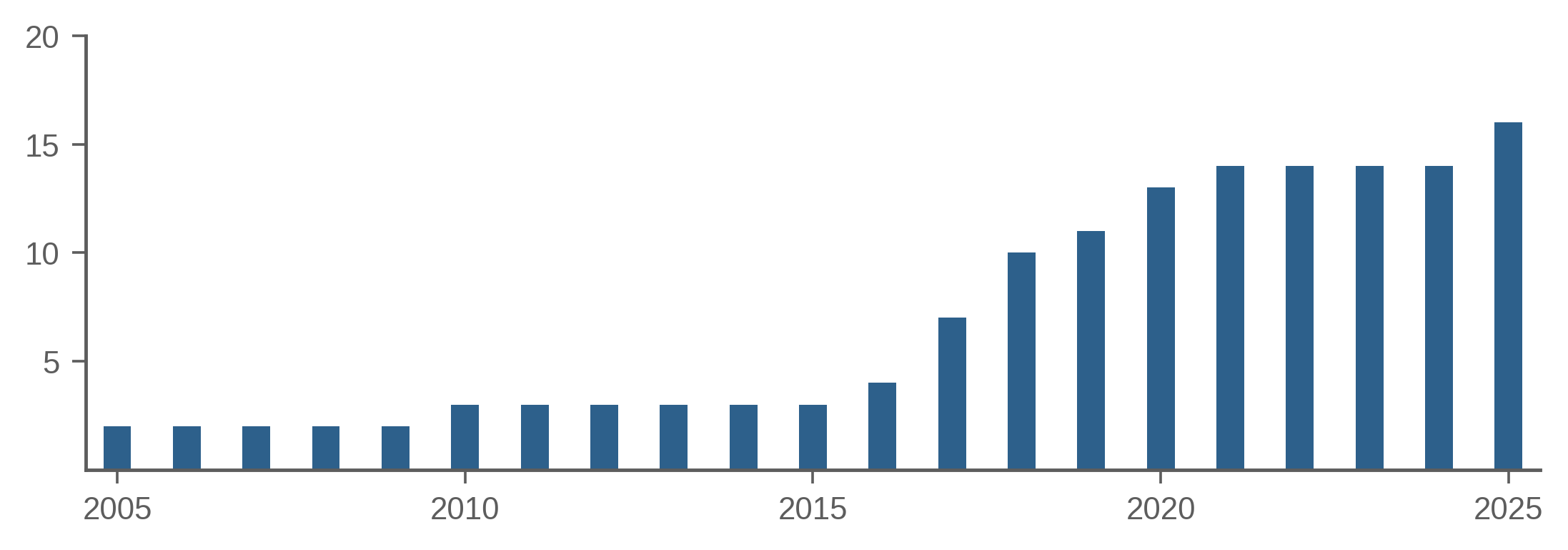
Systematic credit investing has grown meaningfully over the past decade. The number of dedicated systematic strategies has increased (Figure 1), allocators are increasingly allocating to them, and traditional discretionary managers are integrating systematic elements into their investment processes. This growth has been supported by electronification of corporate bond markets and advances in AI, which are improving implementation efficiency, expanding the investable universe, and accelerating quantitative credit research.
To understand why these trends are supportive of systematic credit, we must first clarify what we mean by the term. In the broader world of corporate bonds, “systematic credit” has become an ambiguous catch-all label for almost any application of quantitative methods to trading, investing, or risk management, including hedge funds, systematic asset managers, smart beta strategies, quantamental approaches, and even market making. In this note, we use systematic credit more precisely to describe fundamentally driven, benchmark-relative corporate bond strategies that apply purely quantitative methods and a rules-based approach to bond selection and portfolio construction.
In the discussion that follows, we describe why electronification and AI are especially favorable to systematic investing in credit markets and how managers’ success will depend on their ability to integrate new technologies and adapt to a changing market structure.
Figure 1: Number of Asset Managers with Dedicated Systematic Credit Offerings
Electronification of Corporate Credit Markets
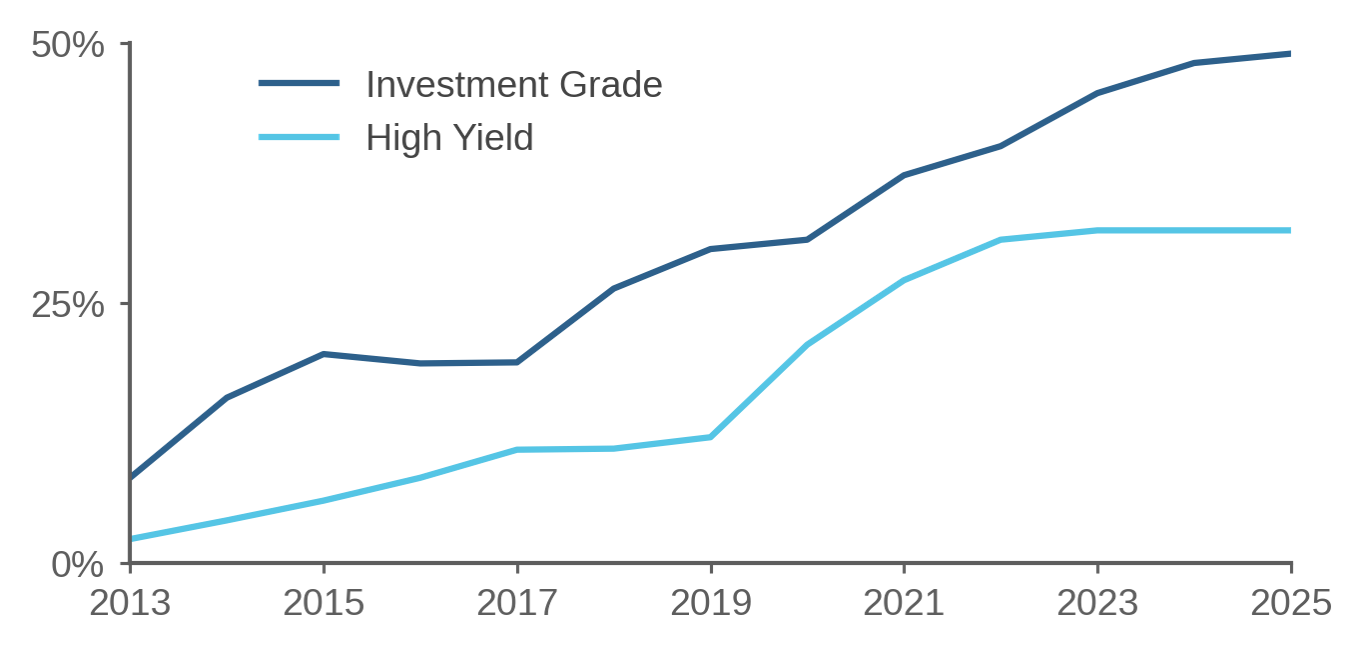
Electronic execution has steadily gained share in corporate bond trading, which even a decade ago was still dominated by manual, voice-based workflows (Figure 2). This shift has materially changed the structure of public credit markets, increasing trading volumes and broadening participation. Dealers now use algorithmic pricing to respond to quote requests and facilitate portfolio trades. These more efficient and scalable execution mechanics have increased liquidity, reduced trading frictions, and improved price discovery.
Figure 2: Share of Electronic Corporate Bond Trading in the U.S.
Beyond its effects on trading, electronification has also improved the quantity and quality of available credit market data, an equally important if less visible development. This has enabled more precise modeling of liquidity, fill probabilities, and market impact, as well as more rigorous ex post evaluation of execution quality.
The associated reductions in execution costs and risks have benefited all market participants, but they are especially important for systematic managers. Systematic credit strategies tend to have higher turnover than discretionary approaches, which magnifies the impact of lower execution costs.
A second advantage for systematic managers stems from the importance of “breadth” to their investment approach, whether in the context of credit or equity markets. Greater liquidity and transparency have expanded the investable universe, increasing the number of independent investment views that managers can express and enhancing their flexibility to translate those insights into active portfolio positions.1 Systematic managers are especially well positioned to benefit from these developments because their forecasting and portfolio construction approaches are built to scale. In contrast, discretionary managers typically face higher incremental research and implementation costs when expanding coverage.
Despite the improvements associated with electronification, corporate bond markets remain murky and complex. As in the equity world, liquidity is dispersed across venues. But unlike in equities, there is no guarantee of best execution or even a consolidated market view. Adding to this opacity, anonymous trading protocols can obscure counterparty visibility and increase adverse selection risk.
As a result, systematic credit managers face important decisions about their investment in implementation. The extent to which they benefit from electronification will depend on how effectively they aggregate fragmented liquidity information, model market impact and liquidity risk, and develop the technologies, methodologies, and relationships needed to access execution opportunities efficiently.
AI in Active Credit Investing
AI has long been part of the systematic investor’s analytical toolkit, though the underlying methods were not always labeled as AI. For more than a decade, systematic managers have used techniques such as machine learning and natural language processing to enhance return forecasts and model risk.
Systematic credit is no exception. In forecasting individual bond returns, AI is used to increase the flexibility and precision of predictive models. It is integral to the extraction of signals from diverse forms of structured and unstructured alternative data, including regulatory filings, earnings-call transcripts, and news reports. AI is also used to model subtle but economically important relationships across issuers.
The advances in generative AI, however, have rapidly changed how research is done in systematic credit. Until recently, managers largely had to build their own AI capabilities from publicly available libraries. Today, they can purchase access to sophisticated AI platforms that are more capable than systems that even large managers could have developed internally just a few years ago. Once a do-it-yourself activity, working with AI now involves engaging with a rapidly evolving industrial ecosystem of models, data providers, and software platforms.
Perhaps even more consequential, modern AI tools are dramatically streamlining data processing, code generation, and iterative testing, accelerating cycles of hypothesis generation and evaluation. Conversational AI assistants significantly eased programming in recent years, and newer agentic systems now allow researchers to create analytical machinery using natural language. As a result, the level of programming expertise required to execute sophisticated quantitative research has fallen.
But as with electronification, the advances in AI hardly guarantee success in credit investing. Crucially, AI does not replace judgment in knowing what analytical tools to build or how to evaluate whether they have been implemented correctly. Even if researchers no longer write each line of code themselves, they must be able to verify and adapt AI-generated code. AI agents can produce outputs that appear correct while violating intended analytical safeguards.
Researchers also still need expertise and judgment in developing meaningful hypotheses, understanding their data, choosing appropriate statistical tests, avoiding lookahead and other biases in analysis, and interpreting results. As technical barriers to conducting analysis fall, the risks of misguided, redundant, and faulty research rise.
In addition, larger firms with established systematic research platforms have advantages of scale in the application of AI and alternative data. One is cost. While the price of access to AI models has fallen, the cost of data continues to rise. Firms that cannot afford to spend millions of dollars on input information may not be able to compete. But data access alone is not enough. Managers also need industrialized research infrastructure to manage data resources over time and to conduct analysis with consistent rigor. Moreover, AI is likely to magnify the benefits of firms’ proprietary data and insights.
In summary, while access to sophisticated AI tools is becoming increasingly democratized, the benefits will not accrue uniformly across managers. Success will depend on access to differentiated data, the quality and robustness of research infrastructure, and the organizational capabilities needed to evaluate and deploy new technologies efficiently. Firms that have already invested heavily in these resources are likely to enjoy a meaningful advantage. At the same time, democratization of access to powerful AI tools does not diminish the importance of investment acumen, research expertise, and disciplined process. While AI lowers certain technical barriers to quantitative research, it does not replace the skills required to formulate hypotheses, evaluate evidence, and allocate research resources effectively.
Conclusion: Structural Change and the Future of Systematic Credit
Corporate bond markets are evolving in ways that increasingly favor systematic approaches. Electronification has improved liquidity, lowered trading frictions, and expanded the investable universe. Advances in AI and data-intensive research methods are improving the speed, scale, and sophistication of return forecasting. Together, these developments strengthen the core drivers of active performance: forecast accuracy, breadth, and implementation efficiency.
But these same developments are also reshaping competition within systematic credit because their benefits are unlikely to accrue uniformly across managers. Firms with differentiated data, robust research infrastructure, deep investment and research expertise, and sophisticated implementation capabilities will be best positioned to benefit from these changes.
Endnotes
- From the standpoint of the Fundamental Law of Active Management, higher forecasting breadth reduces noise in return prediction, and more flexibility to manage risk and implementation frictions implies more efficient transfer of forecasting insights into active portfolio positions. Both changes improve expected risk-adjusted returns.
Don't miss the next Acadian Insight
Get our latest thought leadership delivered to your inbox
Legal Disclaimer
These materials provided herein may contain material, non-public information within the meaning of the United States Federal Securities Laws with respect to Acadian Asset Management LLC, BrightSphere Investment Group Inc. and/or their respective subsidiaries and affiliated entities. The recipient of these materials agrees that it will not use any confidential information that may be contained herein to execute or recommend transactions in securities. The recipient further acknowledges that it is aware that United States Federal and State securities laws prohibit any person or entity who has material, non-public information about a publicly-traded company from purchasing or selling securities of such company, or from communicating such information to any other person or entity under circumstances in which it is reasonably foreseeable that such person or entity is likely to sell or purchase such securities.
Acadian provides this material as a general overview of the firm, our processes and our investment capabilities. It has been provided for informational purposes only. It does not constitute or form part of any offer to issue or sell, or any solicitation of any offer to subscribe or to purchase, shares, units or other interests in investments that may be referred to herein and must not be construed as investment or financial product advice. Acadian has not considered any reader's financial situation, objective or needs in providing the relevant information.
The value of investments may fall as well as rise and you may not get back your original investment. Past performance is not necessarily a guide to future performance or returns. Acadian has taken all reasonable care to ensure that the information contained in this material is accurate at the time of its distribution, no representation or warranty, express or implied, is made as to the accuracy, reliability or completeness of such information.
This material contains privileged and confidential information and is intended only for the recipient/s. Any distribution, reproduction or other use of this presentation by recipients is strictly prohibited. If you are not the intended recipient and this presentation has been sent or passed on to you in error, please contact us immediately. Confidentiality and privilege are not lost by this presentation having been sent or passed on to you in error.
Acadian’s quantitative investment process is supported by extensive proprietary computer code. Acadian’s researchers, software developers, and IT teams follow a structured design, development, testing, change control, and review processes during the development of its systems and the implementation within our investment process. These controls and their effectiveness are subject to regular internal reviews, at least annual independent review by our SOC1 auditor. However, despite these extensive controls it is possible that errors may occur in coding and within the investment process, as is the case with any complex software or data-driven model, and no guarantee or warranty can be provided that any quantitative investment model is completely free of errors. Any such errors could have a negative impact on investment results. We have in place control systems and processes which are intended to identify in a timely manner any such errors which would have a material impact on the investment process.
Acadian Asset Management LLC has wholly owned affiliates located in London, Singapore, and Sydney. Pursuant to the terms of service level agreements with each affiliate, employees of Acadian Asset Management LLC may provide certain services on behalf of each affiliate and employees of each affiliate may provide certain administrative services, including marketing and client service, on behalf of Acadian Asset Management LLC.
Acadian Asset Management LLC is registered as an investment adviser with the U.S. Securities and Exchange Commission. Registration of an investment adviser does not imply any level of skill or training.
Acadian Asset Management (Singapore) Pte Ltd, (Registration Number: 199902125D) is licensed by the Monetary Authority of Singapore. It is also registered as an investment adviser with the U.S. Securities and Exchange Commission.
Acadian Asset Management (Australia) Limited (ABN 41 114 200 127) is the holder of Australian financial services license number 291872 ("AFSL"). It is also registered as an investment adviser with the U.S. Securities and Exchange Commission. Under the terms of its AFSL, Acadian Asset Management (Australia) Limited is limited to providing the financial services under its license to wholesale clients only. This marketing material is not to be provided to retail clients.
Acadian Asset Management (UK) Limited is authorized and regulated by the Financial Conduct Authority ('the FCA') and is a limited liability company incorporated in England and Wales with company number 05644066. Acadian Asset Management (UK) Limited will only make this material available to Professional Clients and Eligible Counterparties as defined by the FCA under the Markets in Financial Instruments Directive, or to Qualified Investors in Switzerland as defined in the Collective Investment Schemes Act, as applicable.
Legal Disclaimer
These materials provided herein may contain material, non-public information within the meaning of the United States Federal Securities Laws with respect to Acadian Asset Management LLC, BrightSphere Investment Group Inc. and/or their respective subsidiaries and affiliated entities. The recipient of these materials agrees that it will not use any confidential information that may be contained herein to execute or recommend transactions in securities. The recipient further acknowledges that it is aware that United States Federal and State securities laws prohibit any person or entity who has material, non-public information about a publicly-traded company from purchasing or selling securities of such company, or from communicating such information to any other person or entity under circumstances in which it is reasonably foreseeable that such person or entity is likely to sell or purchase such securities.
Acadian provides this material as a general overview of the firm, our processes and our investment capabilities. It has been provided for informational purposes only. It does not constitute or form part of any offer to issue or sell, or any solicitation of any offer to subscribe or to purchase, shares, units or other interests in investments that may be referred to herein and must not be construed as investment or financial product advice. Acadian has not considered any reader's financial situation, objective or needs in providing the relevant information.
The value of investments may fall as well as rise and you may not get back your original investment. Past performance is not necessarily a guide to future performance or returns. Acadian has taken all reasonable care to ensure that the information contained in this material is accurate at the time of its distribution, no representation or warranty, express or implied, is made as to the accuracy, reliability or completeness of such information.
This material contains privileged and confidential information and is intended only for the recipient/s. Any distribution, reproduction or other use of this presentation by recipients is strictly prohibited. If you are not the intended recipient and this presentation has been sent or passed on to you in error, please contact us immediately. Confidentiality and privilege are not lost by this presentation having been sent or passed on to you in error.
Acadian’s quantitative investment process is supported by extensive proprietary computer code. Acadian’s researchers, software developers, and IT teams follow a structured design, development, testing, change control, and review processes during the development of its systems and the implementation within our investment process. These controls and their effectiveness are subject to regular internal reviews, at least annual independent review by our SOC1 auditor. However, despite these extensive controls it is possible that errors may occur in coding and within the investment process, as is the case with any complex software or data-driven model, and no guarantee or warranty can be provided that any quantitative investment model is completely free of errors. Any such errors could have a negative impact on investment results. We have in place control systems and processes which are intended to identify in a timely manner any such errors which would have a material impact on the investment process.
Acadian Asset Management LLC has wholly owned affiliates located in London, Singapore, and Sydney. Pursuant to the terms of service level agreements with each affiliate, employees of Acadian Asset Management LLC may provide certain services on behalf of each affiliate and employees of each affiliate may provide certain administrative services, including marketing and client service, on behalf of Acadian Asset Management LLC.
Acadian Asset Management LLC is registered as an investment adviser with the U.S. Securities and Exchange Commission. Registration of an investment adviser does not imply any level of skill or training.
Acadian Asset Management (Singapore) Pte Ltd, (Registration Number: 199902125D) is licensed by the Monetary Authority of Singapore. It is also registered as an investment adviser with the U.S. Securities and Exchange Commission.
Acadian Asset Management (Australia) Limited (ABN 41 114 200 127) is the holder of Australian financial services license number 291872 ("AFSL"). It is also registered as an investment adviser with the U.S. Securities and Exchange Commission. Under the terms of its AFSL, Acadian Asset Management (Australia) Limited is limited to providing the financial services under its license to wholesale clients only. This marketing material is not to be provided to retail clients.
Acadian Asset Management (UK) Limited is authorized and regulated by the Financial Conduct Authority ('the FCA') and is a limited liability company incorporated in England and Wales with company number 05644066. Acadian Asset Management (UK) Limited will only make this material available to Professional Clients and Eligible Counterparties as defined by the FCA under the Markets in Financial Instruments Directive, or to Qualified Investors in Switzerland as defined in the Collective Investment Schemes Act, as applicable.