I’ve previously argued that the stock market is not in an AI bubble. But that doesn’t mean that everything is sunshine and rainbows. I view today’s stock market as having both unusually large upside and unusually large downside. In this piece, I want to sketch out the worst-case scenario for global equities.
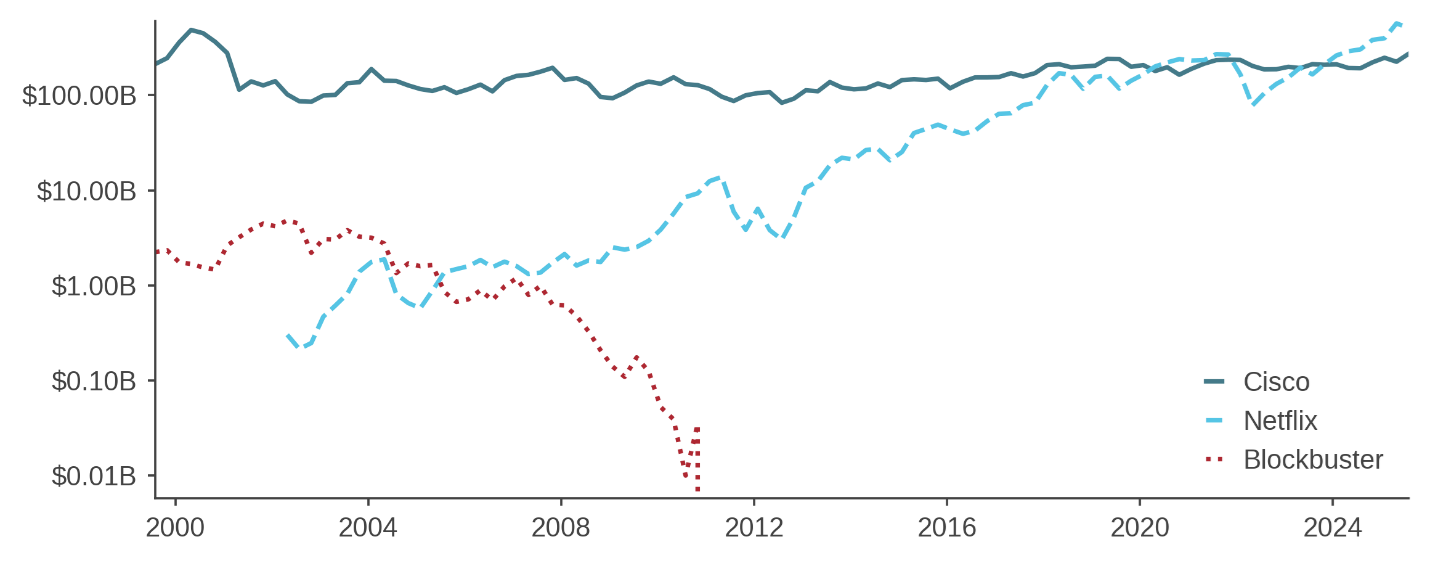
Consider the U.S. stock market in 1999. Figure 1 shows the market capitalization of three firms: Cisco, Blockbuster Video, and Netflix.[1] Much of the recent debate revolves around whether today’s market resembles Cisco in 1999. But that’s hardly the worst-case scenario. The worst-case scenario is that today’s market resembles Blockbuster. Innovation always has winners and losers, and if most currently public firms turn out to be AI losers, then the market is heading for a fall.
In 1999, Cisco was correctly perceived as a technology winner, and it subsequently experienced enormous growth in revenue and profits. This growth was, however, insufficient to justify Cisco’s valuation, and thus Cisco’s price subsequently fell as the tech-stock bubble deflated. But the main story in Figure 1 is that Cisco, while overvalued in 1999, was a technology winner.
In contrast, Blockbuster suffered greatly from the rise of the internet. Like the mighty herds of buffalo that once roamed America, Blockbuster went from being ubiquitous (with more than 9,000 locations in 2004) to nearly extinct (today, a single video rental location remains in Bend, Oregon).
Netflix prospered at the expense of Blockbuster. It was a private company in 1999 and did not IPO until 2002. Thus, if you held the U.S. stock market, you did not benefit from Netflix’s initial success from 1999 to 2002, for the simple reason that Netflix was not publicly traded in 1999.
So, why did stock prices go up in the 1990s? Market participants perceived that the winners would greatly benefit from the internet and the losers would not be greatly hurt. In retrospect, it appears that the market overestimated technology’s benefit to Cisco and underestimated technology’s harm to Blockbuster, neglecting to realize that many of the benefits would flow to private firms like Netflix. Similarly, I expect many of the big AI winners will be companies that currently do not exist.
Figure 1: Market capitalizations of Cisco, Blockbuster, and Netflix
Log scale, billions of USD
 Source: Acadian, based on data from Bloomberg. Past performance is no guarantee of future results. Companies mentioned are for illustrative purposes only and are not recommendations to buy or sell specific securities.
 Currently, market participants seem to think the U.S. stock market is dominated by winners. The worst-case scenario is that investors change their minds and decide that existing public firms are like Blockbuster (doomed to extinction). That’s not what happened in the 1990s, but it is a possibility going forward.
AI is a wonderful new technology that will enhance economic productivity. It may seem strange to think it might hurt the stock market, because historically new technology has often produced stock market booms, as with railroads, automobiles, and the internet. But stock market booms are not the only possible outcome of innovation. The impact depends on whether the stock market contains more technology winners or more technology losers.
Consider the 1920s stock market boom. It involved exciting new products such as the automobile and fast-growing companies such as General Motors. But the 1920s boom had losers as well as winners. Among the losers were firms and individuals involved in what was then a central part of the economy: horses.
Around 1920, the U.S. horse population reached its peak with approximately one horse for every four humans. The rise of the internal combustion engine was a devastating blow to the equine industrial complex. Some firms successfully made the transition to the post-horse economy, with blacksmiths becoming auto mechanics and wagonmakers becoming automakers (for example, NYSE-listed Studebaker). But mostly, the horse economy simply collapsed in the 1920s.
America experienced an agricultural depression and waves of bankruptcies in the 1920s, partly due to the demise of horses. The shrinking horse population may have even played a role in the overall economic collapse of the 1930s, with the Commerce Department concluding in 1933 that it “is one of the main contributing factors of the present economic situation … has affected the entire country.”[2]
As it turned out, almost all horse-related enterprises were privately held. The stock market boomed in the 1920s partly because auto-related firms were public but horse-related firms were not. Imagine an alternative universe where, in 1920, the stock market consisted only of horse-related firms, with General Motors and U.S. Steel being private but the hypothetical firms General Horses and U.S. Hay being public. In that universe, stock prices would fall in the 1920s.
The process by which horses and video stores are replaced by new technology from new firms is called “creative destruction.” According to Schumpeter (1942), “Creative Destruction is the essential fact about capitalism.” Many economic models predict that new technology should cause stock prices to fall, not rise, as Schumpeterian creative destruction impacts existing firms (see Jovanovic and Rousseau (2005) for a literature review). Hobijn and Jovanovic (2001) claim that this dynamic caused U.S. stock prices to fall after the introduction of the microprocessor in the early 1970s. I’m not sure their story is a plausible explanation for the horrific bear market of the 1970s, but it’s definitely a plausible scenario for the impact of AI going forward. And it doesn’t matter whether this obsolescence narrative is true; it matters whether market participants believe the narrative is true.
AI will likely unleash a wave of economic growth. But the benefits of this growth may not flow to today’s shareholders. Ritter (2005) studied different countries and found that, contrary to conventional wisdom, high future economic growth does not generally benefit current shareholders:
If an economy grows because personal savings are invested in new firms … the gains on this capital investment do not accrue to existing shareholders.
As always, The Stock Market Is Not The Economy or simply TSMINTE.
I’m an AI optimist. I’m hoping AI will generate scientific breakthroughs that make everybody richer, healthier, and happier. But these breakthroughs would not necessarily be great for existing public companies. Goldman Sachs has a list of equities most at risk from AI, including firms in IT services, payroll services, and business process outsourcing. Share prices of these firms have fallen in half since 2021. But what if that’s just the beginning? What if AI cures all diseases, decimating the health care sector? What if AI invents cold fusion, making oil firms worthless? Maybe all existing stocks belong on the list of at-risk firms.
To quote Donald Rumsfeld, you go to war with the army you have, not the army you want. Similarly, you go to the AI revolution with the stock market you have, not the stock market you want. As Blockbuster shareholders discovered, creative destruction is no fun when it’s your wealth that’s getting creatively destroyed.
Endnotes
[1] References to this and other companies should not be interpreted as recommendations to buy or sell specific securities. Acadian and/or the author of this post may hold positions in one or more securities associated with these companies.
[2] “1930 Census of Agriculture: The Farm Horse,” United States Department of Commerce, 1933.
References
Hobijn, Bart, and Boyan Jovanovic. "The information-technology revolution and the stock market: Evidence." American Economic Review 91, no. 5 (2001): 1203-1220.
Jovanovic, Boyan, and Peter L. Rousseau. "General purpose technologies." In Handbook of Economic Growth, vol. 1, pp. 1181-1224. Elsevier, 2005.
Ritter, Jay R. "Economic growth and equity returns." Pacific-Basin Finance Journal 13, no. 5 (2005): 489-503.
Schumpeter, Joseph A. Capitalism, Socialism, and Democracy. 1942.




