
A Compelling Middle Ground: The Enhanced Equity Advantage
Key Takeaways
- Enhanced equity is designed to offer an attractive middle ground between passive allocations and traditional active strategies: modest but consistent benchmark-relative outperformance.
- Its performance benefits derive from tightly controlling active risk, which leads to purer, though more modest, expression of an active manager’s investment views and better diversification.
- The advantages of enhanced should appeal both to allocators who are stepping away from traditional active strategies due to risk, cost, or governance considerations, and to passive investors under pressure to beat their benchmarks.
Investors are increasingly interested in enhanced equity, i.e., active strategies that take low active risk, with tracking error (TE) typically in the 1-2% range. Enhanced strategies closely track an index and strive to outperform it. Compared to traditional active strategies, they seek more consistent outperformance and smaller drawdowns at the cost of a more modest expected return target. Many allocators will find this tradeoff a good match for their investing objectives.
Enhanced equity is not a new concept. Twenty-five years ago, Ronald Kahn advocated that such strategies “should receive the largest allocations of capital from most pension plans” (Kahn, 2000). This advice has gone largely unheeded. Instead, many investors have gravitated towards a combination of two extremes—a sizable passive allocation coupled with high-active-risk, concentrated equity portfolios. Whatever the reason for the past underappreciation of enhanced equity—perhaps its benefits were poorly understood or discussions involving modest return targets did not spark broad enthusiasm—we are receiving more inquiries about it now from a broad range of allocators. In this overview, therefore, we explain its appeal.1
Enhanced as a Middle Ground
To motivate the discussion, Table 1 compares enhanced strategies, passive allocations, and traditional active strategies with respect to several attributes, including risk and return potential, costs, and ease of implementation. Across these dimensions, enhanced equity raises no obvious red flags. Its balanced nature between passive and traditional active should appeal to many investors. There also is one area in which enhanced positively stands out, consistency of active performance.
Table 1: Pros and Cons of Enhanced Equity Versus Passive and Traditional Active
| Passive | Enhanced | Traditional Active |
Expected Excess Return | None | Low | High |
Implementation Costs & Fees | Low | Modest | High |
Active Risk | None | Low | High |
Active Return Consistency | N/A | High | Modest |
Active Drawdown Risk | None | Low | High |
Oversight/Monitoring Costs | Low | Modest | High |
Customization Potential | Low | Modest | High |
Over the next two sections, we highlight enhanced strategies’ benefits and present intuition to explain their sources. We frame this discussion from the perspectives of two audiences that should take special note of enhanced strategies, “avoiders” and "seekers." By avoiders, we mean allocators who are currently invested in traditional active strategies but who are facing cost pressures, governance scrutiny, or concerns around reliability of performance. By seekers, we mean allocators who are currently invested in passive but who need a boost in returns to meet performance targets or who need a more customized portfolio than they can find among available passive vehicles.
For Avoiders: Higher Risk-Adjusted Returns, Less Drama
Traditional active strategies can experience prolonged periods of material underperformance due to their high active risk budgets. Moreover, even when such strategies are performing well, ongoing monitoring requirements may challenge an allocator’s governance structure. The more concentrated the portfolio and the higher the active risk, the greater these challenges become.2
Enhanced equity shines in comparison. It is tightly risk-controlled, so that when executed correctly its total returns will largely reflect the underlying benchmark’s performance. Therefore, enhanced strategies are unlikely to suffer deep and prolonged drawdowns versus their benchmarks. While investors should not expect enhanced equity to deliver the same level of benchmark-relative returns targeted by traditional active strategies, the more modest active return expectation comes with meaningfully lower tracking error and a higher expected active risk-return tradeoff (i.e., information ratio, or IR).
Figure 1 presents empirical evidence consistent with this assertion. Focusing on a sample of strategies benchmarked to global indexes from eVestment,3 The table groups strategies into three tiers based on realized active risk, Enhanced (TE ≤2% per annum), Traditional Active (2-6% TE), and High TE (≥6%), and it plots the average IR for each category. We present results over the past two decades, 2015-2024 and 2005-2014.4
Figure 1: Average Information Ratios by Level of Active Risk—Global Active Equity Strategies
Global long-only equity strategies from eVestment sorted by TE during the sample period
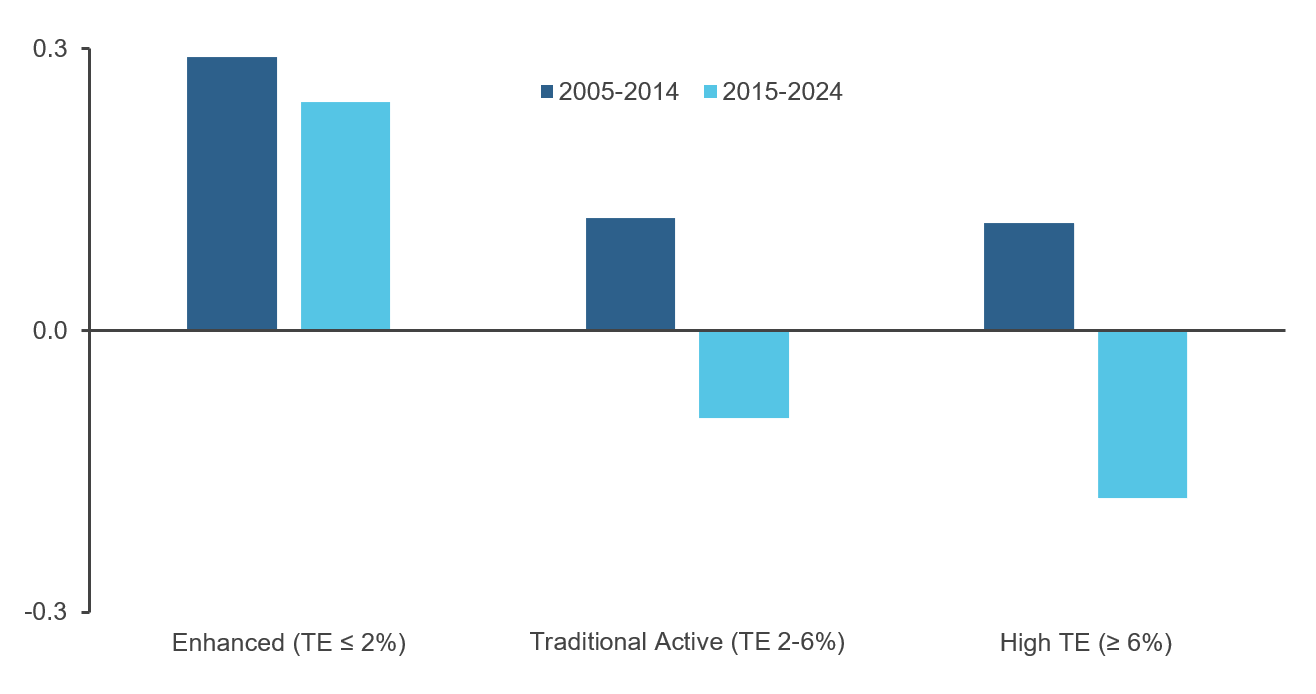
The chart not only confirms that low-TE strategies have generated more consistent performance, but it also helps us understand why these strategies are becoming more popular now. Over the last 10 years, the average traditional active strategy underperformed its benchmark, while enhanced strategies delivered positive active returns.
SOURCES OF HIGHER RISK ADJUSTED RETURNS
There is an intuitive explanation for the attractive risk-return tradeoff of enhanced strategies: the tight control on tracking error leads to a purer (though more modest) expression of an active manager’s skill. To understand why, we compare a traditional systematic active and an enhanced strategy that are both built around the same investment view. That is, each strategy maximizes alpha based on the same return and risk forecasts; the only difference is in their tracking error budgets. We expect the enhanced strategy to have a higher risk-adjusted return for three principal reasons.
1) Better transfer of negative views into the portfolio
By construction, the traditional active strategy will seek larger overweights compared to the enhanced strategy, which—in a long-only context—must be “funded” by correspondingly large underweights across the portfolio. However, most benchmark stocks cannot be materially underweighted, since even the median stock in a typical market index only has a one to two basis-point weight. So, to fund its relatively large overweights, a traditional active manager may need to underweight (or just not hold) more and more stocks, gradually moving from very negative to mildly negative alphas, or perhaps even to stocks on which the firm has a neutral view. The more concentrated the strategy, the more acute the issue becomes: a manager that only holds 20 benchmark stocks cannot differentiate the views that it expresses on the hundreds (or even thousands) of the remaining stocks in the benchmark – all these stocks end up with maximum underweights. Moreover, the need to fund overweights often causes traditional active managers to meaningfully underweight the largest benchmark constituents. For example, in recent years many active managers blamed poor performance on underweighting the Magnificent 7 to source overweights elsewhere in the portfolio.5 In contrast, an enhanced strategy has smaller active funding needs, so it may be able to hold neutral stocks at roughly benchmark weight, partially underweight stocks with mildly negative alphas, and divest completely only stocks with the most negative investment views.
2) Improved control of macro risk
The larger a manager’s desired overweights, the more likely it is that some unwanted risks will sneak into the resulting portfolio. To illustrate, consider a manager with a highly positive forecast on Novo Nordisk, the Danish healthcare company, which had a 0.3% weight in MSCI ACWI as of March 31, 2025. Even if the portfolio had zero exposure to all other Danish stocks, the moment the Novo Nordisk overweight exceeds 0.2%, the manager would be overweight the Danish country and currency, since Denmark’s overall index weight is about 0.5%. Even without any view on Denmark or the Danish Krone, the manager would be unable to avoid active risk from these sources if it took a larger position in the company. Since an enhanced strategy would take smaller overweights, it should incur smaller unintended macro exposures.
3) Prioritization of distinctive investment insights
Risk and return both matter for portfolio construction. Even a stock with a high return forecast may not be a good candidate for an overweight if that positioning would consume too much of the overall risk budget. For a long-only strategy, one implication of the tight tracking error budget is that portfolio construction cannot take much undiversifiable risk in maximizing alpha. As a result, enhanced strategies naturally skew towards alpha derived from (distinctive) idiosyncratic stock selection rather than from more commonplace sources associated with exposure to systemic risk, including countries and industries but also generic versions of factors like value and momentum.6 As the tracking error budget is loosened, alpha maximization is likely to be supported by taking more risk that is undiversifiable. All three of the above benefits arise because enhanced strategies are incentivized to take many small active positions, with less interference from the long-only constraint. This leads to purer exposure to a manager’s insights and better diversification.
BETTER DRAWDOWN BEHAVIOR
All active strategies can (and will) have periods of underperformance. This is a problem not only due to the erosion of asset owners’ capital, but also because extreme performance may induce poor decision making.7 From that perspective, enhanced strategies are less of a governance burden. Their drawdowns are likely to be less frequent for the reasons outlined above, less severe due to the lower active risk target, and less likely to coincide with whatever may lead the news on a given day. In other words, enhanced equity’s risk profile makes the strategy “a good kind of boring.” The lack of drama can increase an asset owner’s staying power and ultimately lead to a higher long-term return than if the asset owner invested in—but gave up on—a very attractive strategy that has a higher active risk profile.
For Seekers: Index Outperformance and Customizability
As Table 1 makes clear, passive equity is enticing because it is simple, cheap, and easy to monitor. But passive also has the downside that its expected return cannot be (much) higher than that of the index it tracks, even if some vehicles seek to at least partly offset drag from implementation costs and fees by passing through securities lending revenue or via dividend withholding tax management. For allocators seeking a performance boost relative to their benchmarks, enhanced strategies offer a better alternative.
Why would we expect enhanced strategies to outperform passive? The main reason is portfolio manager skill. For the reasons already explained, a skillful manager with a low active risk budget should be able to generate modest and consistent excess returns. But there is another, less-apparent reason.
The indexes that passive vehicles track often rebalance to rigid schedules based on mechanical rules. The predictability presents a potential source of drag on performance of the indexes themselves and execution risk for the passive products that slavishly track them, because informed market participants can and do trade ahead of the passive funds (e.g., buying securities that will be added to the index and selling those that will be deleted).8 Enhanced managers can naturally ameliorate such risks by keeping their trading programs confidential, by incorporating transaction cost estimates into portfolio construction, and through fundamental and technical signals embedded in their stock return forecasts.
Moreover, the composition of many popular benchmarks is subject to discretionary oversight, which calls into question just how “passive” those indexes really are.9 The S&P 500 first comes to mind, with a committee that governs not only choices over constituents but also over the timing and process of index changes.10 But MSCI and FTSE/Russell also make discretionary calls, for example regarding whether countries should be classified as emerging or developed and how various classes of stocks should be weighted.11
Finally, investors who need to customize their portfolios have additional reason to consider enhanced strategies instead of passive. While there are literally millions of indexes available from a variety of providers ("there’s an index for that”), there still may not be a precise match for an asset owner’s specific needs. Moreover, custom index construction often requires judgment, meaning that the resulting portfolios are no longer “passive” in any meaningful sense. By comparison, an explicitly active solution offered through a customized enhanced strategy can offer an appealing alternative.
Conclusion
Historically underutilized, enhanced equity offers a compelling middle ground between passive indexing and traditional active management. In seeking to deliver modest but consistent excess returns with controlled active risk, enhanced equity strategies should appeal to both investors who are stepping away from traditional active strategies due to risk, cost, or governance considerations and to passive investors who are under pressure to beat their benchmarks.
In contrast, the popular “barbell” approach of pairing large passive allocations with a few high-conviction bets is more complex, as it requires navigating two polar-opposite types of investing approaches. This approach may have a place, particularly where true manager skill is more evident or where market inefficiencies are more pronounced. But for many asset owners and use cases, enhanced equity may offer a practical and appealing solution.
Appendix: eVestment Dataset for Figure 1
Dataset includes long-only strategies from eVestment’s Global All Cap Equity, Global Large Cap Equity, and Global Enhanced Equity universes with the following exclusions:
- Low-volatility, sector/industry-focused, dividend/income focused, options-focused, and thematic strategies.
- Strategies that have preferred benchmarks from an unknown index provider or blended benchmarks.
- Strategies that did not survive the full decade over which tracking error and active returns are calculated.
- Strategies with tracking error over the relevant decade that was < 0.5% or > 10%. Returns are net of fees and in USD.
References
Ang, Andrew, Amit Goyal, and Antti Ilmanen, “Asset Allocation and Bad Habits,” Rotman International Journal of Pension Management, Vol. 7 No. 2 (2014): 16-27.
Burnham, Terence C., Harry Gakidis, and Jeffrey Wurgler, “Investing in the Presence of Massive Flows: The Case of MSCI Country Reclassifications.” Financial Analysts Journal 74 No. 1 (2018): 77-87.
Goyal, Amit and Sunil Wahal, “The Selection and Termination of Investment Managers by Plan Sponsors,” Journal of Finance, 63(4) (2008): 1805‒1847.
Harvey, Campbell R., Michele Mazzoleni, and Alessandro Melone, “The Unintended Consequences of Rebalancing,” Working paper, 2025.
Kahn, Ronald, “Most Pension Plans Need More Enhanced Indexing,” ETFs and Indexing (2000): 65-71.
Li, Sida, “Should Passive Investors Actively Manage Their Trades?,” Working paper, 2021.
Pavlova, Anna and Taisya Sikorskaya, “Benchmarking Intensity,” Review of Financial Studies, 36(3) (2023): 859-903.
Petajisto, Antti, "The index premium and its hidden cost for index funds," Journal of Empirical Finance, 18 (2) (2011): 271–288.
Endnotes
- Although we take the perspective of a long-only asset owner in this note, allowing shorting in extension strategies is an idea that is currently attracting interest from asset owners as a method of generating meaningfully higher excess returns.
- See “Concentrated Portfolio Managers: Courageously Losing Your Money,” Acadian, March 2025 and “Concentrated Equity: Standing Out but Not Outstanding,” Acadian, October 2024.
- See the Appendix for specification of the dataset.
- The Enhanced categories are modest in size, containing 10 and 17 strategies in each period, respectively.
- The Magnificent 7 refers to Microsoft, Apple, Netflix, Alphabet, Meta, Amazon, and Nvidia. References to these and other companies should not be interpreted as recommendations to buy or sell specific securities. Acadian and/or the authors of this paper may hold positions in one or more securities associated with these companies.
- Generic value and momentum, and other style factors, feature prominently in risk models because portfolios that load on them tend to realize greater volatility.
- See, for example, the aptly titled “Asset Allocation and Bad Habits” by Ang et al. (2014) or “The Selection and Termination of Investment Managers by Plan Sponsors” by Goyal and Wahal (2008).
- For discussion of risks of mechanical index tracking and index rebalance effects, see Smart Beta: Constrained Quantitative Active Management, Acadian, January 2015 and Passive Bubbles?, Acadian, July 2017 (available on request). Academic research on the impact of predictable rebalancing on index returns includes: Petajisto (2011), which estimated material index performance drag associated with rebalances of the S&P 500 and Russell 2000 based on data through the mid-2000s; Li (2021), which found that ETFs that spread out execution around rebalancing dates improve performance versus trading at the close on the implementation date; Pavlova and Sikorskaya (2023), which argues that the extent to which stocks are owned by benchmark-tracking funds is associated with performance after additions/deletions. In a recent paper, Harvey et al. (2025) suggest that predictable trading by asset owners, not just around index reconstitutions, exposes them to price pressure effects similar to those described here.
- For additional discussion suggesting that allocators treat benchmark indexes as active constructs, see Reflections on the Ukraine Crisis: Watershed for EM Investing?, Acadian, July 2022.
- According to S&P, “constituent selection is at the discretion of the Index Committee and is based on the eligibility criteria.” See S&P Dow Jones Indices: S&P U.S. Indices Methodology, March 2025, p. 12 at https://www.spglobal.com/spdji/en/documents/methodologies/ methodology-sp-us-indices.pdf. As an example of discretion in how stocks are added, when Tesla was included in the S&P 500, the committee delayed its addition by two quarters relative to the date on which the stock satisfied inclusion criteria and considered adding the stock in two tranches.
- For discussion of the performance implications of country reclassifications as developed, emerging, and frontier, see Burnham et al. (2018). For discussion around the haircut applied to China A-shares’ weight in the MSCI Emerging Market Index, see Polarizing Views: China’s Impact on EM Investing, Acadian, December 2021.
eVestment Disclaimer
eVestment Alliance, LLC and its affiliated entities (collectively, “eVestment”) collect information directly from investment management firms and other sources believed to be reliable, however, eVestment does not guarantee or warrant the accuracy, timeliness, or completeness of the information provided and is not responsible for any errors or omissions. Performance results may be provided with additional disclosures available on eVestment’s systems and other important considerations such as fees that may be applicable. Not for general distribution and limited distribution may only be made pursuant to client’s agreement terms. All managers in an eVestment category are not necessarily included. Copyright 2012-2026 eVestment Alliance, LLC. All Rights Reserved.
Legal Disclaimer
These materials provided herein may contain material, non-public information within the meaning of the United States Federal Securities Laws with respect to Acadian Asset Management LLC, Acadian Asset Management Inc. and/or their respective subsidiaries and affiliated entities. The recipient of these materials agrees that it will not use any confidential information that may be contained herein to execute or recommend transactions in securities. The recipient further acknowledges that it is aware that United States Federal and State securities laws prohibit any person or entity who has material, non-public information about a publicly-traded company from purchasing or selling securities of such company, or from communicating such information to any other person or entity under circumstances in which it is reasonably foreseeable that such person or entity is likely to sell or purchase such securities.
Acadian provides this material as a general overview of the firm, our processes and our investment capabilities. It has been provided for informational purposes only. It does not constitute or form part of any offer to issue or sell, or any solicitation of any offer to subscribe or to purchase, shares, units or other interests in investments that may be referred to herein and must not be construed as investment or financial product advice. Acadian has not considered any reader's financial situation, objective or needs in providing the relevant information.
The value of investments may fall as well as rise and you may not get back your original investment. Past performance is not necessarily a guide to future performance or returns. Acadian has taken all reasonable care to ensure that the information contained in this material is accurate at the time of its distribution, no representation or warranty, express or implied, is made as to the accuracy, reliability or completeness of such information.
This material contains privileged and confidential information and is intended only for the recipient/s. Any distribution, reproduction or other use of this presentation by recipients is strictly prohibited. If you are not the intended recipient and this presentation has been sent or passed on to you in error, please contact us immediately. Confidentiality and privilege are not lost by this presentation having been sent or passed on to you in error.
Acadian’s quantitative investment process is supported by extensive proprietary computer code. Acadian’s researchers, software developers, and IT teams follow a structured design, development, testing, change control, and review processes during the development of its systems and the implementation within our investment process. These controls and their effectiveness are subject to regular internal reviews, at least annual independent review by our SOC1 auditor. However, despite these extensive controls it is possible that errors may occur in coding and within the investment process, as is the case with any complex software or data-driven model, and no guarantee or warranty can be provided that any quantitative investment model is completely free of errors. Any such errors could have a negative impact on investment results. We have in place control systems and processes which are intended to identify in a timely manner any such errors which would have a material impact on the investment process.
Acadian Asset Management LLC has wholly owned affiliates located in London, Singapore, and Sydney. Pursuant to the terms of service level agreements with each affiliate, employees of Acadian Asset Management LLC may provide certain services on behalf of each affiliate and employees of each affiliate may provide certain administrative services, including marketing and client service, on behalf of Acadian Asset Management LLC.
Acadian Asset Management LLC is registered as an investment adviser with the U.S. Securities and Exchange Commission. Registration of an investment adviser does not imply any level of skill or training.
Acadian Asset Management (Singapore) Pte Ltd, (Registration Number: 199902125D) is licensed by the Monetary Authority of Singapore. It is also registered as an investment adviser with the U.S. Securities and Exchange Commission.
Acadian Asset Management (Australia) Limited (ABN 41 114 200 127) is the holder of Australian financial services license number 291872 ("AFSL"). It is also registered as an investment adviser with the U.S. Securities and Exchange Commission. Under the terms of its AFSL, Acadian Asset Management (Australia) Limited is limited to providing the financial services under its license to wholesale clients only. This marketing material is not to be provided to retail clients.
Acadian Asset Management (UK) Limited is authorized and regulated by the Financial Conduct Authority ('the FCA') and is a limited liability company incorporated in England and Wales with company number 05644066. Acadian Asset Management (UK) Limited will only make this material available to Professional Clients and Eligible Counterparties as defined by the FCA under the Markets in Financial Instruments Directive, or to Qualified Investors in Switzerland as defined in the Collective Investment Schemes Act, as applicable.