Something’s happening in the U.S. stock market. We see cult stocks and crypto stocks. We see money pouring into leveraged single-stock ETFs and crypto ETFs. And we see dramatic price moves, for example in quantum computing stocks in December 2024. What’s going on?
Here’s one theory: these phenomena partly reflect an influx of Korean retail investors into the U.S. stock market. Last year, I wrote that “the U.S. stock market is Koreafying,” meaning that the U.S. market was starting to behave like the retail-dominated Korean market. What I didn’t realize was that this Koreafying process involves actual Korean retail investors.
Call it the Squid Game market. The main features of the Netflix series Squid Game are (spoiler alert) as follows:
- Ordinary Korean people.
- Taking huge risks to get rich quick.
- Bizarre and violent events.
- It doesn’t end well for most players.
In the U.S. stock market in the past few years, we see:
- Korean retail investors.
- Taking huge risks to get rich quick.
- Bizarre and violent stock price movements.
- ?
A wide variety of evidence suggests that retail investors, of every nation, make poor investment decisions and exhibit “anti-skill” or “perverse stock selection ability.” For example, for retail U.S. investors trading stocks, Barber, Huang, Odean, and Schwarz (2020) find that “intense buying by Robinhood users forecast negative returns.” In the recent boom of options trading, retail U.S. investors lose money on average due to “a trio of wealth-depleting behaviors” according to de Silva, Smith, and So (2023). Thus, we would expect wealth-destroying behavior from Korean retail investors, not because they are Korean, but because they are retail.
I view Korean retail investors today as similar to Robinhood investors in 2021. While quantitatively insignificant relative to the whole stock market, in narrow areas they are a danger to themselves and possibly to others. And even if they don’t impact prices, they might provide useful contrarian signals.
Ordinary Korean People
Koreans can buy U.S. stocks in a variety of ways, including directly and via ETFs trading in the U.S. or in Korea. The entry of Korean retail investors into the U.S. stock market has been growing ever since the pandemic. In 2024, the influx continued:[1]
South Korea’s retail investors are flocking to US equities, betting a stock market rally will continue in the second Donald Trump presidency and frustrated by years of poor share performance at home. Holdings of US stocks by the country’s investors reached a record $112.1bn at the end of 2024, according to Korea Securities Depository data, up 65 per cent from a year earlier.
Now, $112B is chump change compared to total U.S. equity market cap of $62T (only 0.2%). But in some small corners of the market, Korean retail investors are major players.
Let’s look at the evidence as of late-February 2025. Here and elsewhere, my data comes from the Korea Securities Depositary and covers retail traders only (not institutional).[2] Korean retail investors own 31% of the shares of one prominent quantum computing stock and 17% of another one. They own 19% of an AI-related firm involved in small modular reactors. In leveraged ETFs on stocks and crypto, they often own more than 20% of shares outstanding. Among their top-50 U.S. holdings are eight leveraged ETFs, including a 2X single-stock ETF where they own 40%.
Huge risks to get rich quick
In Korea, leveraged single-stock ETFs are illegal, along with most forms of non-financial gambling, such as casinos. So, if you’re a risk-loving Korean looking for a big score, then the U.S. stock market is for you. Approximately 12% of Korean retail holdings in the U.S. are in products that are legally prohibited in Korea, according to Kim (2025). Additionally, in Korea, stocks are only allowed to go up by 30% in a single day. In America, the sky’s the limit.
In Squid Game, the contestants are often unaware of the rules and not particularly qualified to play. So too with Koreans buying a 3X leveraged semiconductor ETF: [3]
“So many people buy … that some buy it without even knowing that it’s three-times leverage,” said Park Eun-hye, a 35-year-old employee at a semiconductor firm in the city of Hwaesong near Seoul. It’s hard to find people here who aren’t buying the ETF, she said.
Another buyer said the following:
… leveraged ETFs seemed more suitable for my situation as my seed money was small. I’m still young and my children are little, so this seemed to be the golden time for investment, and that’s why I can continue to be aggressive … Investing in leveraged ETFs in the US might be a way to climb the social ladder in South Korea where there is very little class mobility …
I previously bemoaned the case of the 25-year-old Californian (described in The Wall Street Journal in November 2024), who invested his parent’s retirement money in a 2X single-stock ETF. But he wasn’t alone; Korean retail investors joined him, with net buying of 2X leveraged ETFs for that particular stock in November 2024.
Since that story appeared, the ETF in question has fallen more than 80%. Not a good outcome for the 25-year-old and his parents, nor for Koreans looking to “climb the social ladder.”
Bizarre and violent events
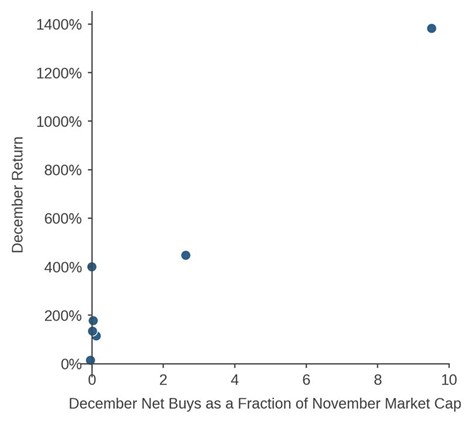
When a flood of money hits small-cap stocks, the result is bizarre and violent price increases. Consider the recent quantum computing frenzy. On December 9, 2024, a quantum computing breakthrough was announced, leading to a rise in U.S.-listed stocks that would allegedly benefit. Figure 1 shows the result for seven U.S.-listed stocks that are generally regarded as quantum stocks (three of them have “quantum” in their name) and where I could find Korean net buying data. The x-axis shows, for December 2024, the total dollar amount of net buying divided by prior month market cap; the y-axis shows total return.
Figure 1 suggest that Korean retail investors contributed to extreme price moves. For example, the rightmost point shows a stock with market cap of about $12M as of November 2024. During December 2024, it experienced $111M of Korean retail net buys and was up about 1,400% at the end of the month. That’s looks like market impact to me! I’m not claiming that Korean retail investors were the only source of volatility – there was obvious fundamental news occurring – but I do think they added fuel to the fire.
Figure 1: Returns of U.S. Quantum-Computing Stocks vs. Net Buying from Korean Retail Investors
December 2024
 Sources: Acadian and Korea Securities Depositary. For illustrative purposes only.
 In addition to reacting to fundamental news, Korean retail money seems to respond to non-fundamental news. Take stock splits, which might generate buying by confused investors. When Nvidia[4] split its stock in 2024, it generated a wave of Korean retail buying.[5]
There have been a series of increasingly freaky events in the U.S. stock market, and I’ve written about some of them. It turns out that many of these events involved Korean retail buying. Here are some examples:
I’m not saying Korean retail investors were the prime movers in these events, but I doubt they were a calming influence.
It doesn’t end well
In every country retail investors on average lose money, including Korean retail investors trading Korean stocks according to Kim (2021). What about their experience trading U.S. stocks? I have not done a comprehensive study, but I examined some epic disasters in U.S. financial history and checked for Korean retail buying around these events. Table 1 shows the results for the impacted securities.
For each disaster, I ask whether the security appeared on the list of the top-50 U.S. securities in terms of net buying by Korean investors during the same or prior calendar month. Since there are many thousands of listed U.S. stocks and ETFs (currently around 7,000 total), it is unlikely that any randomly selected security would appear on the top 50 in any given month. A “no” in the table doesn’t mean Korean retail investors were selling; it just means they weren’t buying enough to make the top 50.
Table 1 shows that Korean retail investors have an uncanny ability to buy securities that are about to crash. For example, consider the collapse of Lehman. Out of all the stocks they could have bought in August 2008, they put Lehman in their top 50. They probably had zero impact on the price of Lehman (their dollar quantities were minuscule in 2008), but they somehow managed to be in the wrong place at the wrong time.
Table 1: Financial Disasters and Korean Retail Net Buying of U.S. Securities
| Event | Month | Relevant security | Top 50 Korean net retail buying |
| | | | prior month | same month |
| Bear Stearns Collapse | March 2008 | BEAR STEARNS COMPANIES | Yes | No |
| Lehman Collapse | September 2008 | LEHMAN BROTHERS HOLDINGS | Yes | Yes |
| Volmageddon | February 2018 | VELOCITYSHARES DAILY INVERSE VIX SHORT TERM | Yes | Yes |
| Crude Oil Goes Negative | April 2020 | VELOCITYSHARES 3X LONG CRUDE OIL ETN | Yes | No |
| Nikola Fraud Alleged | September 2020 | NIKOLA CORP | Yes | No |
| Silicon Valley Bank Collapse | March 2023 | SVB FINANCIAL GROUP | No | Yes |
Sources: Acadian and Korea Securities Depositary. For illustrative purposes only. Now, Table 1 is not a proper test of predictive ability, it’s only a suggestive first look. And perhaps the table would look the same using retail investors from the U.S. or Australia. The important word in the phrase “Korean retail buying” is not “Korean,” it’s “retail.”
In 2024, Korean retail investors had a happier experience with U.S. stocks, as the market went up and their risky picks went up even more. So, should we conclude that Korean retail investors now have the magic touch?
I doubt it. In the initial episodes of Squid Game, the players seemed to be winning, as measured by the giant piggy bank that kept filling up with money at the end of every round. But by the final episode, almost all the characters were dead. Stay tuned.
Who’s on the other side?
Smart investors know to ask, “who’s on the other side of the trade?” If you’re shorting quantum computing stocks, who’s buying? If you’re starting a 3X leveraged ETF, who’s your target customer? If you’re a CEO trying to jumpstart your stock price by pivoting to bitcoin, who will that attract? The answer in all cases: Korean retail investors.
What are they buying right now? Here’s my summary of their top-50 net buys so far in 2025:
- AI, quantum computing, and robotics
- Nuclear power and other data center plays
- Crypto
Every market has an iconic group of retail investors who, like George Costanza, exemplify bad decisions leading to wealth destruction. In 1929, it was “the little fellow” buying high leverage investment trusts traded on the NYSE. In 1989, it was Japanese salarymen speculating on land and stocks. In 1999, it was mutual fund investors buying growth funds. In 2021, it was Robinhood investors buying meme stocks. Today, perhaps that group is Korean retail investors.
Here’s my advice to retail investors around the globe. Be boring and buy an index fund. When you’re offered a chance to compete in Squid Game, the best decision is not to play at all.
[4] References to this and other companies should not be interpreted as recommendations to buy or sell specific securities. Acadian and/or the author of this post may hold positions in one or more securities associated with these companies.
[5] “Koreans' net purchase of US shares up 42-fold over past week on Nvidia stock split.” The Korea Times, June 9, 2024.
References
Barber, Brad M., Xing Huang, Terrance Odean, and Christopher Schwarz. "Attention‐induced trading and returns: Evidence from Robinhood users." The Journal of Finance 77, no. 6 (2022): 3141-3190.
Kim, Hansoo. “Retail Investors’ Foreign Equity Investment: Characteristics and Implications.” Korea Capital Markets Institute, February 2025.
Kim, Joon-Seok . “Behavioral Biases of Retail Investors in the Stock Market.” Korea Capital Markets Institute, September 2021.
de Silva, Tim, Kevin Smith, and Eric C. So. "Losing is optional: Retail option trading and expected announcement volatility." Available at SSRN 4050165 (2023).



