How will we know when we’re in a speculative bubble? One approach is to look at the relative status of two men: Warren Buffett of Berkshire Hathaway and Michael Saylor of MicroStrategy.[1]
Buffett embodies traditional financial virtues: rational valuations, strong balance sheets, solid profits. At times of speculative excess, these virtues are unfashionable, and Buffett is said to have “lost his touch:”
December 1999, Barron’s: “Warren Buffett may be losing his magic touch.”[2]
May 2021, The Economist: “Suspicion is growing that Mr Buffett has lost his magic touch…”[3]
September 2024, The Economist: “Has Warren Buffett lost his touch?”[4]
This timeline suggests the following rule-of-thumb:
If Warren Buffett’s “lost his touch,” the market’s rising far too much.
On the other end of the spectrum is Saylor, a sort of bizarro-Buffett. MicroStrategy, like Berkshire, is unusual for a publicly traded company in that much of its value consists of its holdings of other assets. But while Berkshire owns boring old companies, MicroStrategy owns bitcoin. Saylor is an ardent bitcoin evangelist who has recently suggested that the price of bitcoin will rise from its current level of around $70K to $13M.[5] Here’s Saylor’s investment thesis as encapsulated in a 2020 tweet:[6]
Bitcoin is a swarm of cyber hornets serving the goddess of wisdom, feeding on the fire of truth, exponentially growing ever smarter, faster, and stronger behind a wall of encrypted energy.
Like Buffett, Saylor has many fans. Here’s Jason Zweig of The Wall Street Journal:[7]
Many investors are convinced it’s worth paying far more for MicroStrategy’s stock than the value of its bitcoin would justify—because Saylor himself warrants what we might call a “genius premium.” He has, they believe, created a perpetual-motion money machine.
Back in the pre-bitcoin era, Saylor was an internet evangelist, and MicroStrategy embodied many elements of the tech stock bubble that peaked in March 2000 (Superbowl advertising in January 2000, vaulting ambitions, amazing stock price rise and fall, and an accounting scandal).
Buffett represents traditional business. Saylor represents futuristic visions. Buffett is folksy. Saylor is crypto-mystical. Buffett embraces the old. Saylor proclaims the new. Buffett is value and mean reversion. Saylor is momentum and exponential growth. Buffett is Apollo (order, logic, clarity). Saylor is Dionysus (liberation, imagination, infinity).
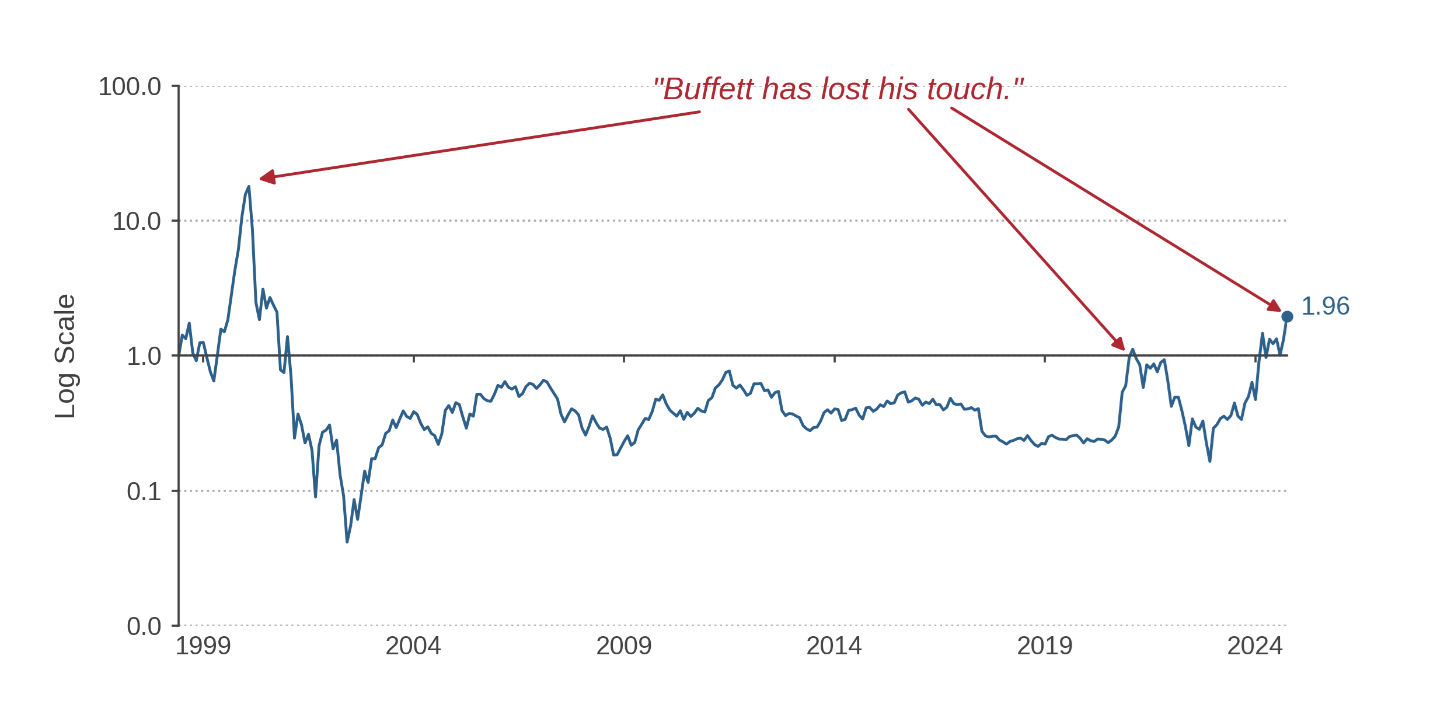
Let’s take a look at the Saylor-Buffett ratio, which I define as the total cumulative return on MicroStrategy divided by the total cumulative return on Berkshire Hathaway, with June 1998 = 1.
Figure 1: Saylor-Buffett Ratio
Ratio of cumulative returns of MicroStrategy / Berkshire Hathaway Class B, June 1998-Oct 2024
Source: Acadian.
The ratio peaked around 18 in February 2000, then spent years below one until reaching parity again in the meme-stock craziness of January 2021. It then fell again as the bubble deflated in 2022. As of October 2024, the Saylor-Buffett ratio is at 2, a level it last touched on its way up in September 1999 and then on its way down in October 2000.
Now, the Saylor-Buffett ratio is just something I made up as opposed to a scientifically valid measure derived from first principles. But it sure looks like an accurate measure of speculative excess. Here we see yet another bubble indicator which says that conditions are not as extreme as March 2000 but are in the same ballpark as 2021.
Let me discuss three more aspects of the Saylor-Buffett dialectic: accounting standards, corporate issuance, and bitcoin.
Accounting standards
Buffett is “a champion of old-fashioned, straightforward accounting.”[8] Saylor, not so much. In its latest earnings report, MicroStrategy announced that it had achieved a “BTC yield” of 17.8% year-to-date. Now, a naïve English-speaking individual might assume that the word “yield” indicates that the firm generated a profit from its investments. Not so. Here’s MicroStrategy:
BTC Yield is a key performance indicator (“KPI”) that represents the % change period-to-period of the ratio between the Company’s bitcoin holdings and its Assumed Diluted Shares Outstanding … The Company uses BTC Yield as a KPI to help assess the performance of its strategy of acquiring bitcoin in a manner the Company believes is accretive to shareholders … BTC Yield is not equivalent to “yield” in the traditional financial context.
Suppose for example that MicroStrategy buys bitcoin but does not change its shares outstanding. If it increases its total holdings of bitcoin by 5%, that will generate a “BTC yield” of 5%. Thus, according to MicroStrategy’s non-traditional approach to the English language, “yield” means “spending on bitcoin.” Welcome to the era of GOAP: Generally Orwellian Accounting Principles.
Corporate issuance
Buffett is an advocate of repurchases; Berkshire has repurchased many of its shares since 2018. In contrast, MicroStrategy has issued equity (as well as debt) to finance bitcoin purchases.
So Buffett has been giving money to shareholders, while Saylor has been taking money from shareholders. But at a conceptual level, you could argue that both men are responding rationally to prevailing market prices, and both are pursuing a “buy low, sell high” strategy.
Buffett perceived Berkshire to be underpriced, and thus bought low. As he said in the latest Berkshire shareholder letter:[9]
All stock repurchases should be price-dependent. What is sensible at a discount to business-value becomes stupid if done at a premium.
In contrast, Saylor has issued equity, which would make sense if he believed that MicroStrategy was overpriced.
You could argue that as of November 2024, both men are acting as if the aggregate stock market level is too high. In the most recent quarter, Berkshire did zero repurchases (for the first time since 2018), has sold some of its equity holdings in other companies, and has built an enormous cash hoard of $325B. In contrast, MicroStrategy recently announced a plan to issue $21B more in equity (“we plan to use the additional capital to buy more bitcoin as a treasury reserve asset in a manner that will allow us to achieve higher BTC Yield”).
Issuance makes MicroStrategy larger, while repurchases make Berkshire smaller. Thus if you calculate the Saylor-Buffett ratio using market capitalization rather than cumulative returns, the ratio today stands at 5% (MicroStrategy has a market cap that is 5% as large as Berkshire), and we’ve already blown through the previous peak of 4% observed during the tech stock bubble. The market-cap-based version of the ratio is more extreme today because investors as a whole have been taking cash from Buffett and giving it to Saylor
Bitcoin
Here’s Buffett’s view of bitcoin as of May 2022:[10]
If you ... owned all of the bitcoin in the world and you offered it to me for $25, I wouldn’t take it, because what would I do with it? I’ll have to sell it back to you one way or another. It isn’t going to do anything.
Here is Saylor’s tweet in response to Buffett’s statement:[11]
#Bitcoin is hope for Berkshire Hathaway.
Um, okay.
One thing is for sure: in the period since this exchange in May 2022, MicroStrategy and bitcoin are both way up. In contrast to the $25 valuation mentioned by Buffett, the current market value of all bitcoin is over $1T, of which around 1% is owned by MicroStrategy.
Where is the market today?
If we look at the big picture, I’m not sure that we’ve reached extreme conditions just yet. Here’s what a full-blown bubble might look like:
- Accounting standards: More firms adopt novel accounting metrics or perhaps Orwellian accounting language.
- Net issuance: We see a massive wave of corporate issuance and reduction in repurchases. We see this now in Berkshire and MicroStrategy, but not yet in the U.S. stock market as a whole.
- Crypto bubble and AI bubble converge: I don’t know if we’re in an AI bubble, but it sure feels like we’re in a crypto bubble. Right now, we have two largely separate narrative streams: AI and crypto. If these two streams cross, it would be bad.[12]
The recent increase in the Saylor-Buffett ratio is one of the many small pieces of evidence (including increased ADR mispricing, history’s largest closed-end fund premium, and survey evidence on investor beliefs) that all seem to be pointing in the same direction: the market is getting frothy.
Endnotes
[1] References to this and other companies should not be interpreted as recommendations to buy or sell specific securities. Acadian and/or the author of this post may hold positions in one or more securities associated with these companies.
[6] https://x.com/saylor/status/1307029562321231873
[11] https://x.com/saylor/status/1786528262786633993?lang=en
[12] “Try to imagine all life as you know it stopping instantaneously and every molecule in your body exploding at the speed of light.” Consequences of crossing the streams as described in Ghostbusters, 1984.




