The Origins of Index Investing
The first Vanguard index fund launched in August 1976 with the goal of closely tracking the return of the S&P 500 at the lowest possible cost. The product’s rationale reflected the prevailing academic theory of the time—market efficiency. If markets are efficient, beating the market consistently by picking individual stocks is unlikely, so holding the overall market cheaply is appealing.
Yet research in the 1980s revealed patterns of return predictability. Small stocks often outperformed large, and “value” stocks—defined by low prices relative to earnings, book value, or past prices—often outperformed “growth” stocks. The academic research that identified these return patterns reinforced systematic portfolio strategies that had already existed in discretionary form. Value investing, for instance, dates at least to Graham and Dodd in 1934, and growth investing gained attention through Fisher in 1958.
Gene Fama and Ken French summarized a decade of work by proposing factors that captured small-cap and value outperformance, but they labeled them as “factors” rather than “mispricings.” The idea was that small and value stocks earned higher returns because they were riskier, preserving the notion of market efficiency.
The Advent of Style Indexing
With this backdrop, Russell invented passive style indexes in 1987, and Vanguard introduced investable style index funds soon after in 1992. Russell’s initial rationale was benchmarking:1 consulting clients who hired active managers needed to know if outperformance was due to genuine stock-picking skill or merely to a bias toward value or growth stocks. If a manager’s tilt toward either style could explain their returns, that was important information for evaluating skill.
Russell also anticipated that value and growth indexes might become investment products. Investors could either capitalize on “the expected long-term outperformance of value stocks” or take a tactical preference for growth if they believed growth would outperform over certain periods. In addition, investors could employ a style fund to complete their portfolios, neutralizing any unintentional bias or “hole” left by active managers.
When Vanguard launched its style index funds in 1992, this pair of funds allowed investors to express a preference for one style or the other. John Bogle later “bemoaned his progeny,”2 believing that these funds tempted investors to chase whichever style had recently performed better. The growth of these style-labeled index funds has been dramatic. From modest beginnings, value- and growth-labeled funds now total nearly $1.6 trillion in net assets. A significant portion of these assets reside with eight major fund complexes, including Vanguard and BlackRock, and most are in ETFs rather than traditional mutual funds.
Inferring Investor Beliefs from Their Investment Choices
Over the decades, investors have strongly favored growth-labeled index funds over value-labeled ones. Although value had early academic support, flows and assets under management had shifted decisively toward growth by the late 1990s and have mostly remained that way ever since.
In recent years, financial economists have increasingly used methods from industrial organization to study how consumers select financial products.3 In that spirit, it is natural to use the market for index funds to infer investor beliefs about future returns on value- versus growth-labeled index funds. A simple regression links each fund’s market share (or cumulative flows) to its expense ratio, past performance, and an indicator of whether it is labeled “value” or “growth.” From this, one can infer time-varying estimates of how much higher (or lower) investors believe growth fund returns will be relative to value fund returns.4
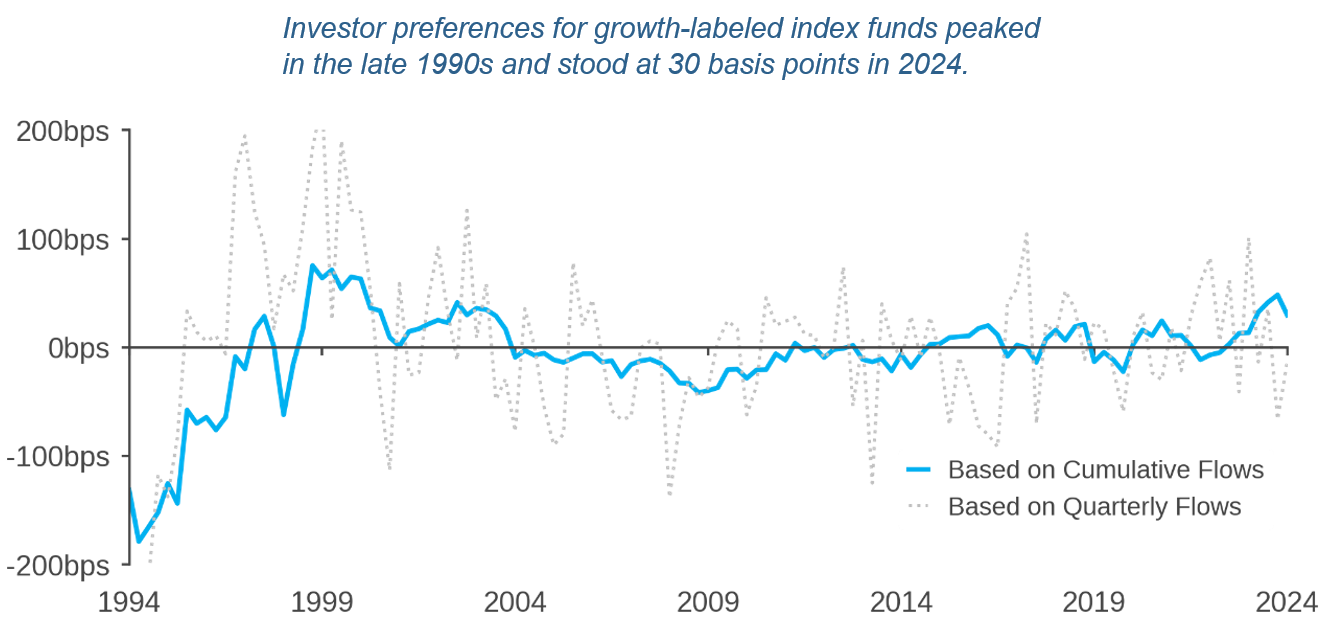
Figure 1 presents the results for the traditional mutual fund subsample. These beliefs peaked at about 75 basis points per year in the late 1990s. By early 2024, they had settled at around 30 basis points. This implies that investors collectively expect growth stocks to outperform value stocks by roughly 0.30% per year, based on how they allocate their money.
Figure 1: Investor Preferences for Value and Growth-Labeled Index Funds
Preference for growth funds over value funds versus historical average, measured in basis points of return per year
Source: Acadian based on data from CRSP® (Center for Research in Security Prices. Graduate School of Business, The University of Chicago. Used with permission. All rightsreserved. Crsp.uchicago.edu.) For illustrative purposes only.Rational Expectations or Sentiment?
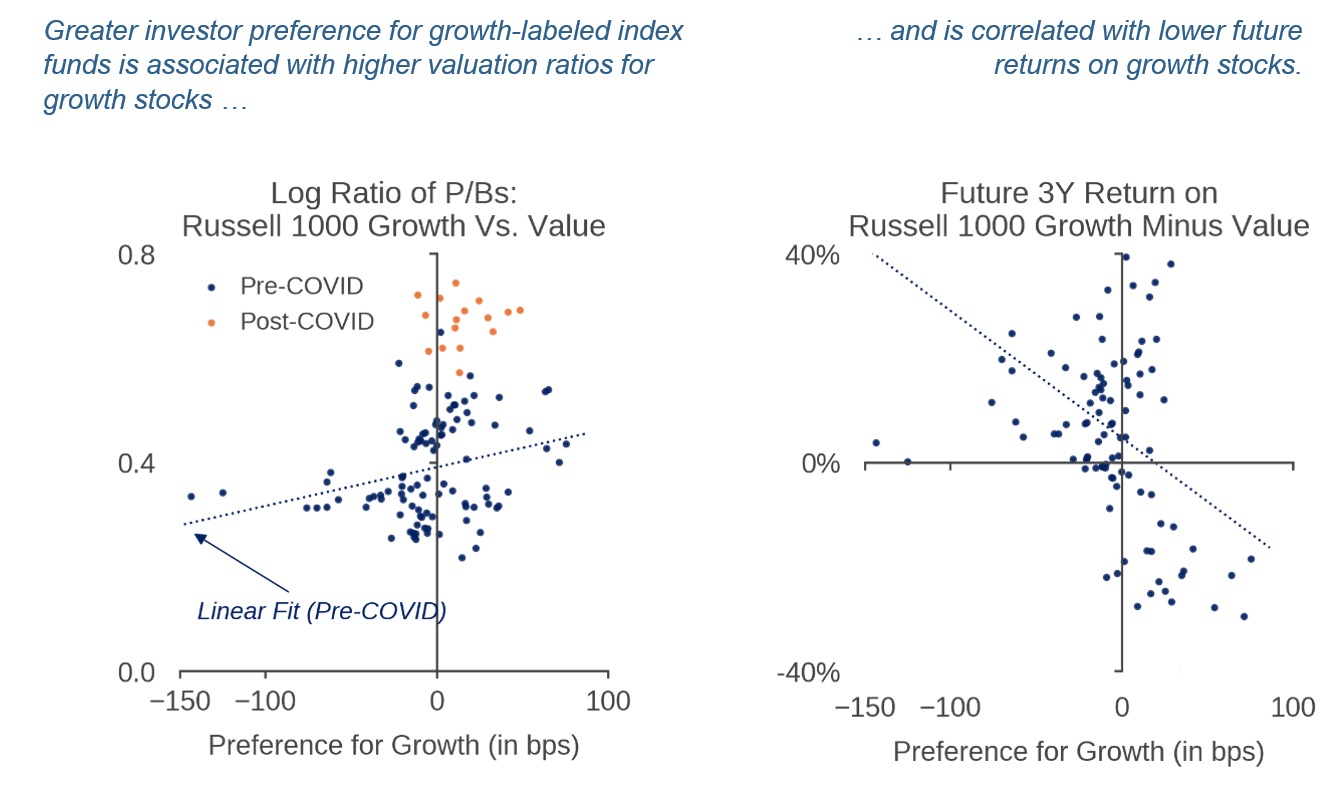
The accuracy of beliefs in Figure 1 has been mixed at best. Past peaks in preferences for growth have coincided with high valuations for growth stocks, followed by stretches of underperformance relative to value. Figure 2 helps to illustrate this dynamic.5 It plots the inferred ex ante beliefs from Figure 1 (how strongly investors favor growth) against two ex post variables: the relative valuations of growth stocks and their subsequent returns versus value stocks. If investors were rationally anticipating higher future returns, we might see strong performance by growth stocks when investors’ beliefs about growth are favorable. Instead, the correlation points in the opposite direction, suggesting that “sentiment for growth” is a more fitting description of investor beliefs than “useful predictions for growth returns.”
Figure 2: Valuations and Future Returns as Functions of Preferences for Growth Funds
Source: Acadian based on Russell Index data (Copyright Russell Investments 1998 – 2025). The charts represent educational exhibits and do not represent investment returns generated by actual trading or actual portfolios. The results do not reflect trading costs and do not reflect advisory fees or their potential impact. For these and other reasons, they do not represent the returns of an investible strategy. Hypothetical results are not indicative of actual future results. It is not possible to invest in any index. Every investment program has the opportunity for loss as well as profit. For illustrative purposes only. Why Do Anomalies Persist?
An enduring question in financial economics is why anomalies—like the historical outperformance of value— persist after discovery. They might not if rational investors “arbitrage” the anomalies—trading against mispricings, buying what is cheap and underpriced, selling what is overpriced, and in the process causing the anomaly to vanish.
Some facts here align with that logic. When Russell and Vanguard introduced value-labeled index funds in 1992, investors indeed favored them early on, presumably in response to evidence of value’s higher average returns. For most of the last thirty years, however, investors favored growth, pushing growth stock valuations higher and leaving value stocks cheaper still. The invention of style index funds has had a perverse effect: rather than eliminating mispricing, the ubiquity of growth-labeled index funds has arguably increased the divergence in valuations, helping growth remain expensive relative to value.
Conclusion
Vanguard launched a pair of index funds in 1992, inspiring many imitators and giving us more than thirty years of data to examine investor beliefs about the returns to value and growth. After an initial market share advantage, investors have reliably preferred growth to value, measured either by the share of assets under management or cumulative flows. Our estimates of investor beliefs about the relative returns to growth peak at 75 basis points per annum in 1999 and now stand at 30 basis points. Those past beliefs have not been predictive of future returns and are more plausibly labeled as “sentiment” for growth and value.
References
Barnes, M., Russell Growth and Value Indexes: The enduring utility of style, Russell Investments, 2021.
Egan, M., A. J. MacKay, and H. Yang, “Recovering investor expectations from demand for index funds.” Review of Economic Studies 89, no. 5 (2022): 2559–2599.
Fama, E. F. and K. R. French, “The cross-section of expected stock returns.” Journal of Finance 47, no. 2 (1992): 427–465.
Fisher, P. A., “Common Stocks and Uncommon Profits,” (Harper & Brothers, 1958).
Graham, B. and D. L. Dodd, “Security Analysis,” (McGraw-Hill, 1934).
Rekenthaler, J., Vanguard’s other index-fund invention: Should Jack Bogle have lamented his subsequent creation?, Morningstar, May 27, 2022.


