Country allocation has long been a focus of discretionary managers in emerging market (EM) equities. Positioning is often explained through vivid narratives that hail countries’ exceptional economic prospects or warn of their vulnerabilities. But timing EM equity markets is far harder than forecasting the countries’ economies. Adding to the challenge, country allocation is also a “low breadth” activity, in that 24 emerging markets offer only a narrow set of independent calls for managers to make. So, in this note, we evaluate whether discretionary EM managers deliver sustained value through country allocation.
In a study of their holdings and performance over the past decade, we find that discretionary EM managers’ active country positioning was costly. We also find evidence that discretionary managers chase past returns in their allocations and that their stock picking may be thematically motivated, and therefore lower breadth than it might first seem.
Reflecting on these results, while a country-focused approach is a natural frame for discretionary EM managers—offering a natural means to focus investment processes that don’t scale well and a basis for compelling storytelling—its continued primacy helps to explain why EM remains such an attractive setting for truly diversified, high-breadth stock selection.
Country Allocation: Cornerstone of Discretionary EM Investing
Expressing country views is part and parcel of what diversified discretionary EM managers do. We find evidence in a study of 50 high-AUM discretionary and systematic strategies from eVestment’s long-only EM universe over the decade from 2015-2024.1
Since we’re interested in the decisions of managers who have the flexibility to allocate across EM, we selected strategies benchmarked to the broad MSCI EM and MSCI EM IMI Indexes and whose names and prospectus descriptions suggest a pan-EM scope.2 (See the Appendix for further detail on the sample.) We see significantly more aggressive country bets among the discretionary managers. The left panel of Figure 1 shows that they derive almost twice the total active weight from country positioning than the non-discretionary group.3 In the right panel, we see that this difference in behavior translates into an appreciably higher fraction of portfolio active risk coming from country sources (means of 40% versus 32%, respectively).4
Figure 1: Country Positioning and Risk — Discretionary Versus Systematic Managers
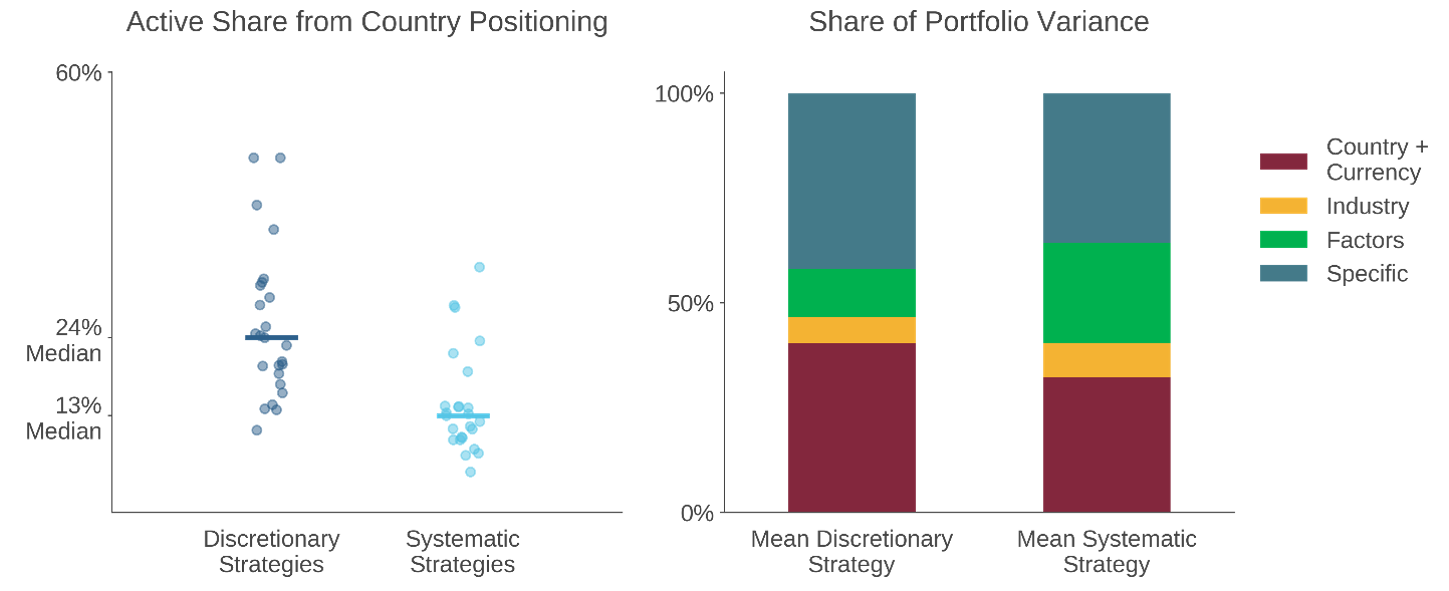
Each dot in the left chart shows the 10-year median (2015-24) of the sum of absolute value of each strategy’s active country positions divided by two. The right chart shows 10-year average percent contributions to variance for discretionary and systematic managers based on a proprietary risk model. Source: Acadian based on sample of strategies described in the main text and appendix and holdings from S&P Capital IQ. For illustrative purposes only.Another contrast in risk drivers across the two groups of strategies accentuates a key difference in how discretionary and systematic EM managers operate. While stock selection is clearly important to both groups (teal), on the systematic side it is associated with substantial factor risk (green).5 On the discretionary side, by comparison, factor risk is modest. Instead, the prominence of country risk within that group suggests that discretionary managers pick and choose stocks in association with macro themes that also drive country positioning. We present further evidence of this in the next section.6
Country Positioning: Help or Harm?
Broadly speaking, discretionary EM managers’ country positioning did not pay off over the past decade. Figure 2 captures this central result of the study.
Figure 2: Discretionary EM Managers’ Active Performance
Cumulative monthly median total active, country selection, and stock selection returns
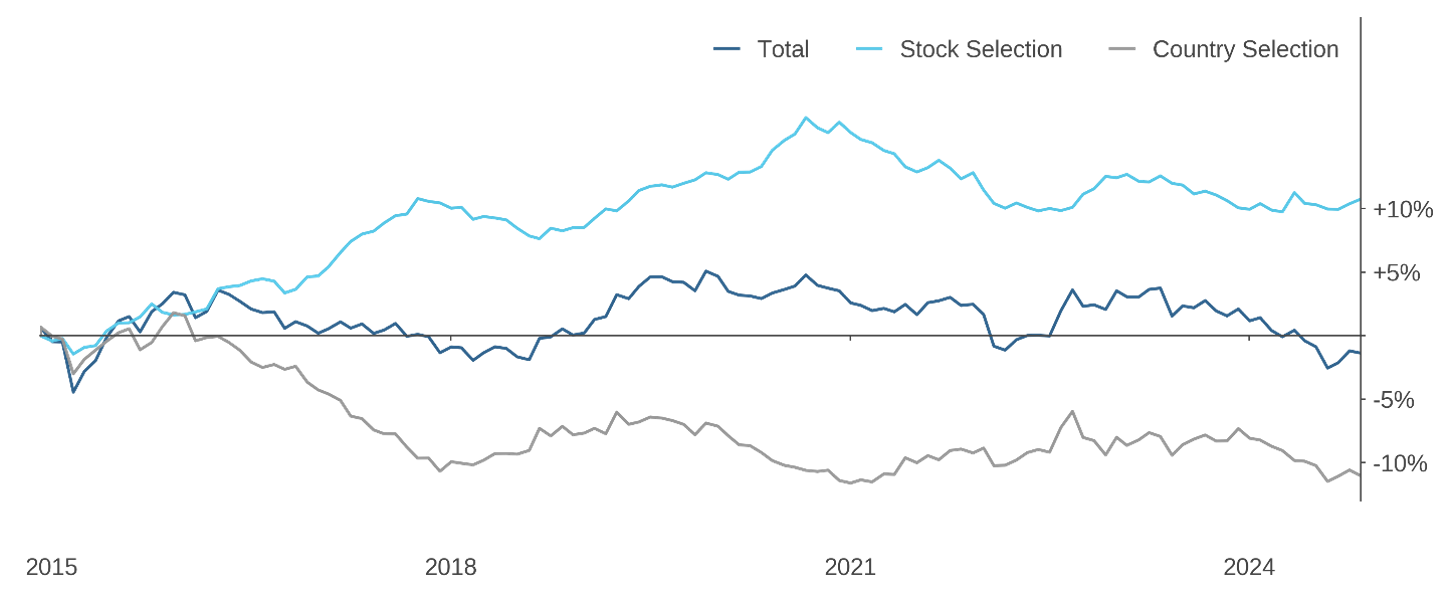
Cumulative monthly median total active, country selection, and stock selection returns from individual Brinson, Hood, and Beebower attributions for discretionary EM strategies in the sample described in the main text and Appendix. Selection returns include the interaction term. Source: Acadian based on holdings from S&P Capital IQ and benchmark weights from MSCI. Copyright MSCI 2025, All Rights Reserved. Unpublished. PROPRIETARY TO MSCI. Past results are not indicative of future performance. For illustrative purposes only.First, as a measure of total active performance—from both country and stock selection—the dark-blue trace cumulates monthly median active returns across the discretionary EM managers. While this group of strategies did well during a few brief stretches, including a period of worldwide growthy speculation from mid-2018 through late-2020, over the full 10-year sample their cumulative median active performance was slightly negative. The chart then breaks out the contributions from country selection and within-country stock selection based on Brinson decompositions of active returns at the individual strategy level. For the typical discretionary EM manager, country positioning (gray) was a material source of net performance drag, offsetting gains from stock selection (light blue).7
Digging deeper, Figure 3 further decomposes both country and stock selection effects into contributions from China and the balance of EM. Two features stand out. First, we see no evidence of skill in country positioning in either segment of EM; the left panel shows that active allocations to both China individually and across the rest of EM meaningfully detracted from performance. Second, China’s singular importance in driving both country and stock selection returns makes it a natural focus of further study in characterizing how discretionary managers operated over the decade.8
Figure 3: Decomposition of Country and Stock Selection Returns among Discretionary EM Managers
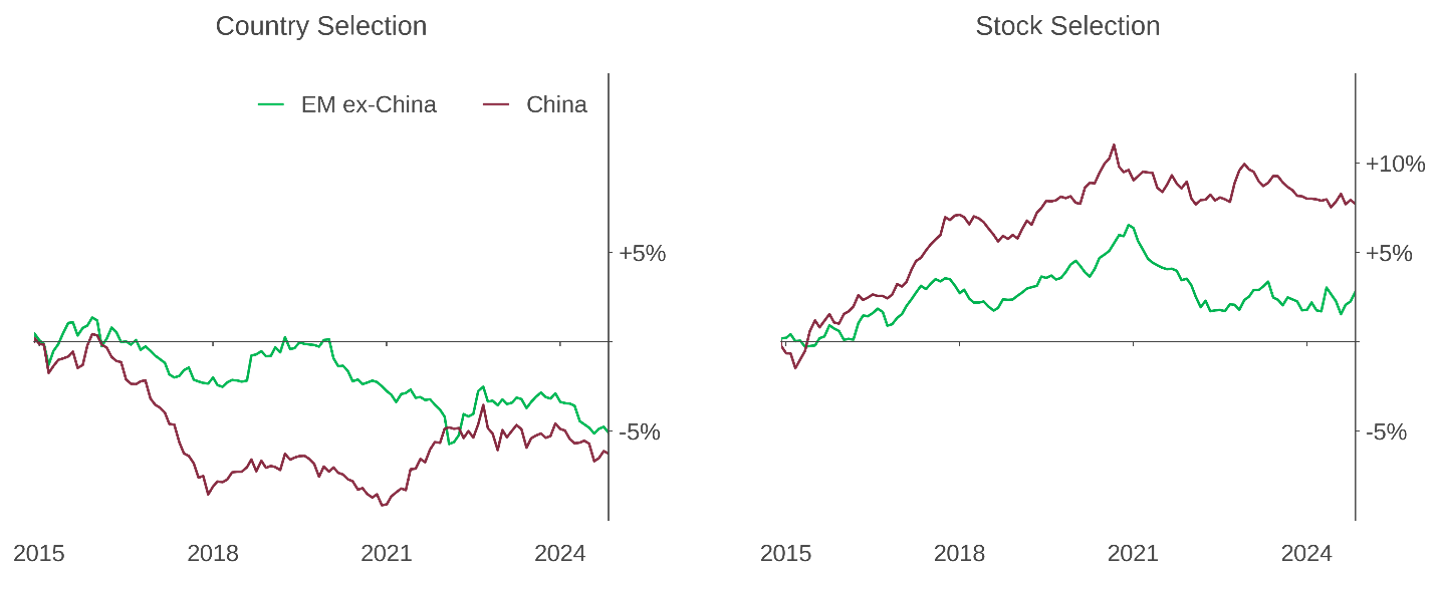
Cumulative monthly median allocation (left) and selection (right) returns from individual Brinson, Hood, and Beebower attributions for discretionary EM strategies in the sample described in the main text and Appendix. Selection returns include the interaction term. Source: Acadian based on holdings from S&P Capital IQ and benchmark weights from MSCI. Copyright MSCI 2025, All Rights Reserved. Unpublished. PROPRIETARY TO MSCI. Past results are not indicative of future performance. For illustrative purposes only.Allocations to China: Case Study in Discretionary Indiscretions
Examination of the positioning that drove China’s contribution to active performance highlights two pernicious indiscretions in discretionary EM investing. First, we see evidence of performance chasing in country allocation. The dark-blue trace in Figure 4 shows that discretionary managers were, broadly speaking, underweight China throughout 2015-2024. But variation in that positioning over time shows clear points of relationship with the trailing EM-relative performance of Chinese stocks (red trace): (1) After Chinese stocks underperformed in 2015, China allocations dipped in 2016. (2) After remaining underexposed as Chinese stocks outperformed in 2017, allocations rebounded only to remain high as Chinese stocks modestly underperformed in late 2018. (3) Most conspicuously, long after the Chinese market started a steady plunge in late 2020 that wiped out startling gains, China allocations continued to ramp up, nearly closing their underweight. (4) Discretionary managers then largely missed the rebound in Chinese stocks after 2023.
Figure 4: Performance Chasing in Discretionary Managers’ China Allocations
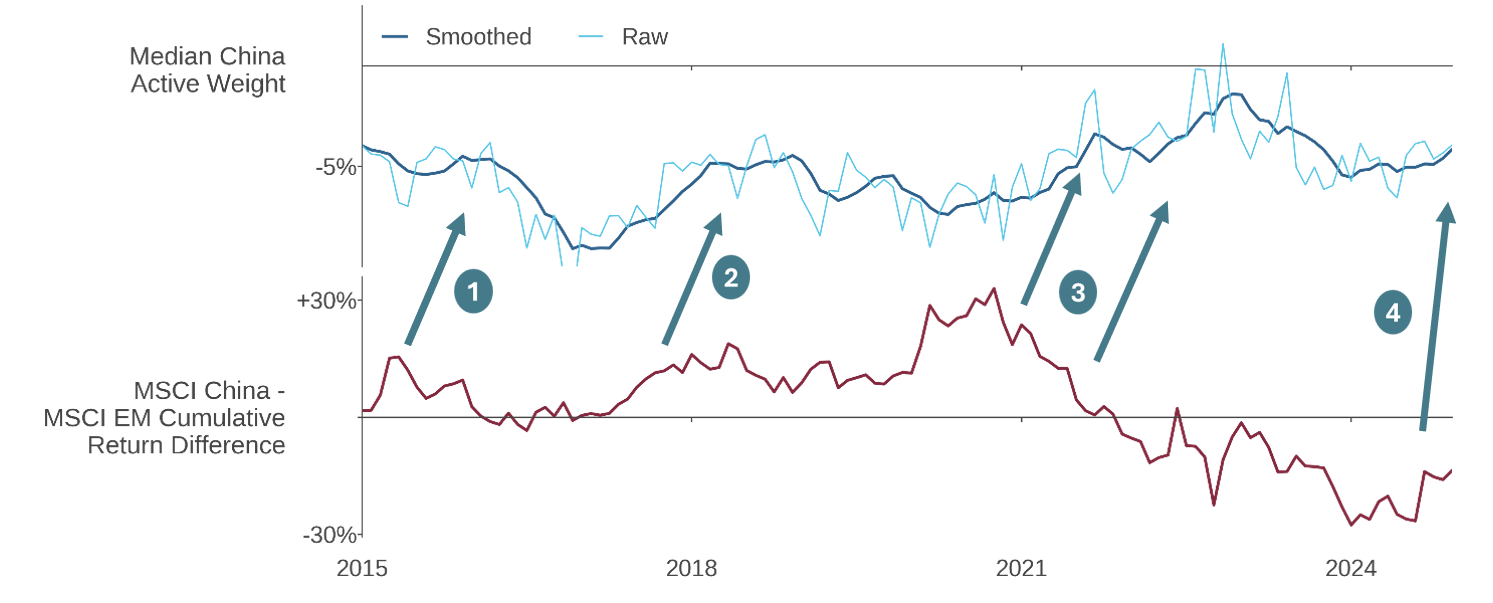
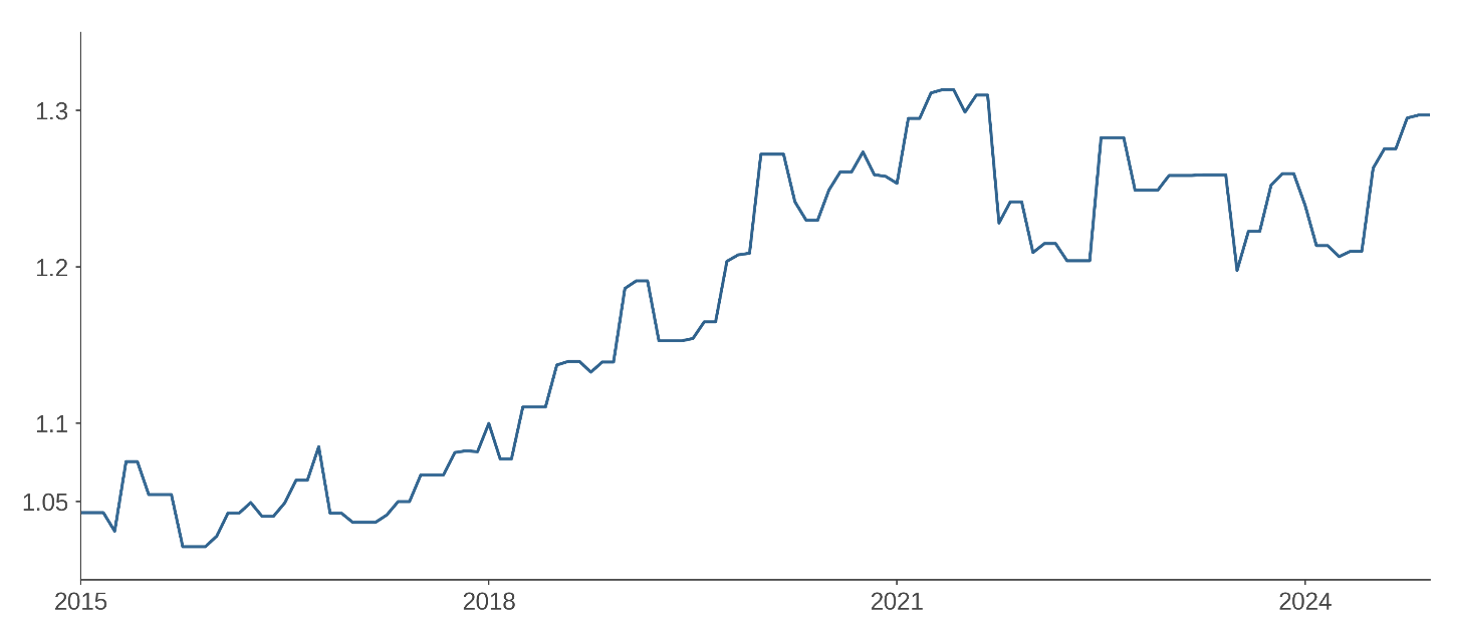
Top chart: Raw and Hodrick-Prescott-filtered median active weight in China among the 25 discretionary active managers relative to the MSCI EM benchmark. Bottom: Cumulative return difference of MSCI China Index minus MSCI EM Index. Source: Acadian based on holdings from S&P Capital IQ and benchmark weights from MSCI. Copyright MSCI 2025, All Rights Reserved. Unpublished. PROPRIETARY TO MSCI. Past results are not indicative of future performance. For illustrative purposes only.Second, examination of stock selection within discretionary China allocations suggests that it had a low-breadth, macro-thematic flavor. Across the discretionary managers, the net-negative active weight in China shown in Figure 4 masks a persistent overweight in onshore Chinese stocks (more than offset by an underweight offshore). Moreover, Figure 5 shows that even as they underweighted the country as a whole, discretionary managers selected into increasingly high-beta Chinese stocks amid a period of growthy speculation worldwide from 2017-2021.9 This evidence suggests a common macro-thematic undercurrent in discretionary EM managers’ stock picking in China. Moreover, we found evidence of similar behavior in other growth-oriented markets, like Taiwan, where discretionary managers selected into a narrow group of semiconductor stocks.
Figure 5: Discretionary Stock Selection in China — A High-Beta Tilt
Median beta to MSCI China of the position-weighted Chinese holdings of the 25 discretionary EM strategies
Source: Acadian based on holdings from S&P Capital IQ and benchmark weights from MSCI. Copyright MSCI 2025, All Rights Reserved. Unpublished. PROPRIETARY TO MSCI. Past results are not indicative of future performance. For illustrative purposes only.A Repairable Problem?
If country allocation detracts from discretionary managers’ performance, then why not just clamp down on it?
One reason is marketing related. As a tool for asset gathering, country calls make for intuitive and compelling storytelling, which is a staple of EM investing. The popularity of thematic narratives around BRICS, the Fragile Five, China, and, most recently, India, just to name a few examples, bear witness. (See the sidebar for discussion of the risks in chasing such macro themes.)
But another reason, consistent with our findings, is that it is probably not so easy for discretionary managers to disentangle stock selection from country calls (or some similar macro-thematic frame). Pursuing stock selection in combination with country views provides a natural basis to shrink the playing field. That’s enormously helpful in the context of a labor-intensive discretionary investment process. How else to address an investment universe of 18,000 stocks across 24 heterogeneous countries, the majority of which are complicated to trade? It would certainly be a challenge to create an assemblage of enough discretionary analysts and PMs to have truly broad and deep coverage across that universe let alone to develop a coherent, well-diversified portfolio from it.
In fact, these difficulties help to explain why high-breadth stock selection in EM continues to present such an attractive opportunity—but only for those managers who have sufficiently scalable and sophisticated investment processes to navigate the environment. Data coverage across EM has grown tremendously over the past 25 years, yet analyst coverage still lags. Trading costs have decreased, yet they remain higher than in developed markets. In other words, in EM there are high barriers to entry for successful high-breadth stock picking to preserve the opportunity set for those who are positioned to engage. This is especially true in the expansive small-cap EM space, and it helps to explain why these stocks remain demonstrably less-well integrated with world markets.
Chasing Macro Themes: The Siren Song of EM Equity InvestingThematic macro narratives have long been a mainstay of EM equity investing. Few captured investors’ imaginations like the BRICs—Brazil, Russia, India, and China—in the early 2000s. The pitch could be summed up in a few words: booming middle classes in India and China and vast natural resources in Brazil and Russia promised outsized economic growth.10 But as an investing proposition, there was a wrinkle. By the time the term “BRICs” was coined in November 2001, these equity markets had already significantly outperformed their EM peers, by almost 9% p.a. over the prior 3 years (Figure 6). Once the narrative took hold, however, after November 2001, the BRICs didn’t fare much better than the rest of EM on a risk-adjusted basis. While the Russian and Chinese markets performed well in absolute terms, Brazil and India ran into headwinds associated with fiscal, political, and governance issues, which the high-level narrative glossed over. While the BRICs epitomized the optimistic side of thematic investing, the emergence of the shorter-lived “Fragile Five” theme in 2013—Brazil, Turkey, Indonesia, South Africa, and India—embodied the cautionary compliment. It flagged a group of otherwise disparate countries that faced current account deficits, currency depreciation, inflationary pressures, and political risk. And there was no doubt that those economic pressures were real. In 2012, the year leading up to the theme’s emergence, those countries’ equity markets underperformed the rest of EM (Figure 6). But after the Fragile Five monicker came into vogue, the theme didn’t pay off for investors. Over the next year, the stocks of those economically vulnerable countries outperformed the rest of EM, evident in slightly higher risk-adjusted returns. Figure 6: How EM Themes Fared — “BRICs” and “Fragile Five”Risk-adjusted returns over periods before and after the themes were coined 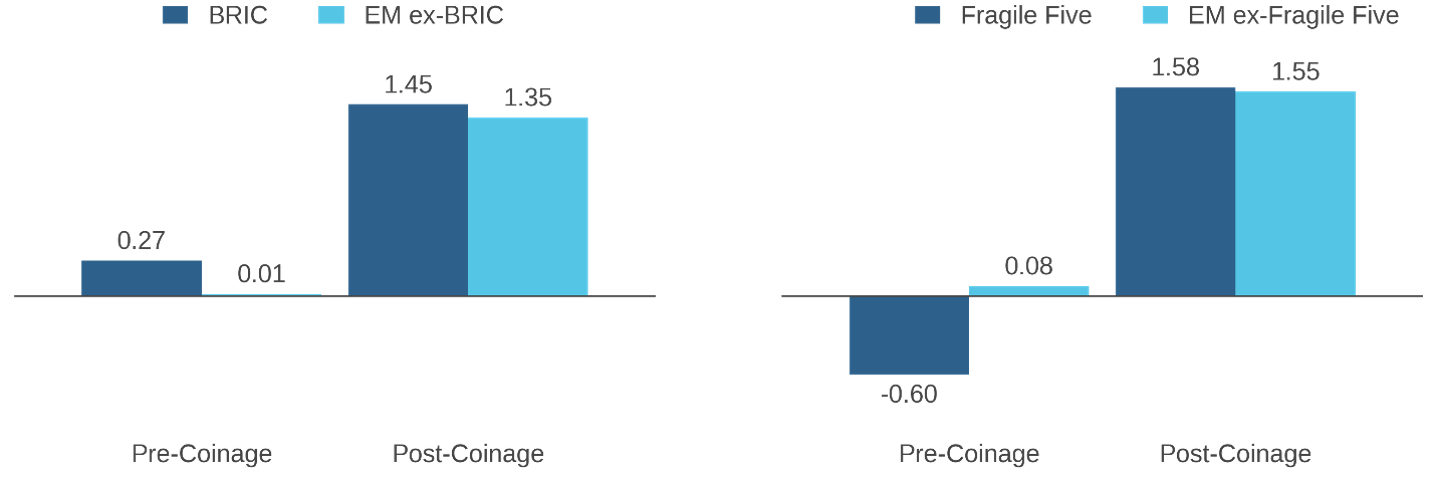
Risk-adjusted USD returns to equally weighted, annually rebalanced portfolios of BRICs and the Fragile Five. For the BRICs, performance is from 36 months prior to and after the theme was labeled in November 2001. For the Fragile Five, performance is from 12 months prior to and after the theme was labeled in August 2013. Sources: Acadian, MSCI Copyright MSCI 2025, All Rights Reserved. Unpublished. PROPRIETARY TO MSCI. For illustrative purposes only.These examples highlight a tragic flaw of thematic macro investing. The themes are usually identified based on hindsight, and often in part because stock prices have already moved in the hoped-for direction. While engaging economic narratives dominate discussion, the crucial and much more difficult question for investors is whether stock markets, which look forward, have already fully priced in the drivers of those narratives. Unfortunately, investors and managers are vulnerable to making decisions in the rear-view mirror, partly due to behavioral biases (e.g., overextrapolation) and partly due to incentives (e.g., for managers, not to stick out to far from the crowd). We see evidence of performance chasing not only in discretionary EM managers’ allocations to China in this study, but also in flows into dedicated China strategies in eVestment. Unfortunately, such returns chasing is hardly unique to China or even EM, however. Academic research has documented it in other allocation contexts and shown the potential harm.11 But in EM, where thematic investing remains so popular, the risk stands out.12 |
Conclusion
Country allocation is a challenging and low-breadth game, which implies that discretionary managers who focus on it need great skill to generate enduring success. Unfortunately, the evidence indicates that discretionary EM managers don’t add value through their country calls.
For most discretionary EM managers, however, we suspect that country allocation is integral to their overall investment approach—inseparable from their stock picking, meaning it wouldn’t be straightforward to rein in. But this also helps to explain the opportunity for truly diversified stock selection that these relatively inefficient markets continue to provide.
Appendix: The Dataset
The sample consists of 25 high-AUM discretionary strategies and 25 high-AUM systematic strategies (labelled “quantitative” in eVestment) that report holdings to S&P Capital IQ and benchmark to either the MSCI EM or MSCI EM IMI indices. We omit strategies that identify as enhanced indexes, with stated style biases, that represent ESG mandates, and that have country or region-specific EM focuses. The sample also omits a small number of strategies that focus almost entirely on single countries, despite being benchmarked to broad indexes. Strategies are selected by ranking them in descending order of AUM as of December 2014. The sample includes strategies that disappeared during the following 10 years. It also includes a few higher-AUM strategies that are incepted between 2015 and 2024. We exclude Acadian strategies from the sample.



