
Corporate Credit and the Institutional Portfolio: Reasserting First Principles
Featured Insights9 MIN
October 2026

Modern AI is expanding the capabilities available to systematic investors, allowing them not only to automate existing processes but to broaden the scope for research and innovation. This evolution raises two questions: how is AI changing the investment process, and what are the implications for investment outcomes?
This paper examines these questions from the perspective of an institutional asset owner, focusing on developments reasonably within view over the next few years rather than speculative technological end-states.
We address the first in two parts: how AI is rearchitecting the analytical underpinnings of the investment process, and how it is shifting the division of responsibilities between people and systems.
The implications for investment outcomes are harder to assess. The assumption that greater productivity and more research firepower will necessarily translate into better active performance is simplistic, because applying AI does not create new underlying mispricings to harvest and active investing is inherently competitive. So in the final section, we highlight four organizational characteristics—people, tools, data, and culture—that can help investors judge which managers are best positioned to turn these new technologies into durable investment advantage.
Systematic investing has always involved a competitive effort to identify mispricings and capture them efficiently. Modern AI changes the technology available for that search, but not the underlying investment problem, either the sources of opportunity or the analytical logic for exploiting them. Markets still reflect the behavior of diverse participants whose biases, incentives, and risk preferences influence stock prices, while managers still seek a forecasting edge through increasingly sophisticated models and rich data.
But modern AI is transforming the investment process by changing the analytical architecture that underlies it and shifting the roles played by people and systems.
In the decade before generative AI captured public attention, machine learning (ML) had already materially expanded systematic investing’s analytical toolkit. It helped managers capture nonlinear and conditional predictive relationships and detect structure in complex data.1 Yet managers still developed and implemented the algorithms largely within their own organizations, typically inserting them into existing workflows as more sophisticated replacements for traditional analytical components.
Viewed functionally, modern AI still sits on a longer continuum of increasingly flexible statistical and ML methods.2 What distinguishes the transition to modern AI, for the purposes of this discussion, is that it is changing how the analytical components of the investment process are organized and sourced.
The core revolution in AI during the early 2020s was one of scale: as models grew enormously large, they became markedly more capable across a broad range of tasks.3 That scale came with new requirements. These huge models—called foundation models—depended on massive training datasets, specialized computing infrastructure, and increasingly sophisticated technologies for training and deployment. (See the sidebar on p. 4 for an intuitive way to understand foundation models.)
Those requirements pushed important parts of the analytical stack outside the investment organization, increasing managers’ reliance on an emerging industrial ecosystem of specialized AI model developers, chipmakers, cloud providers, and other technology suppliers.
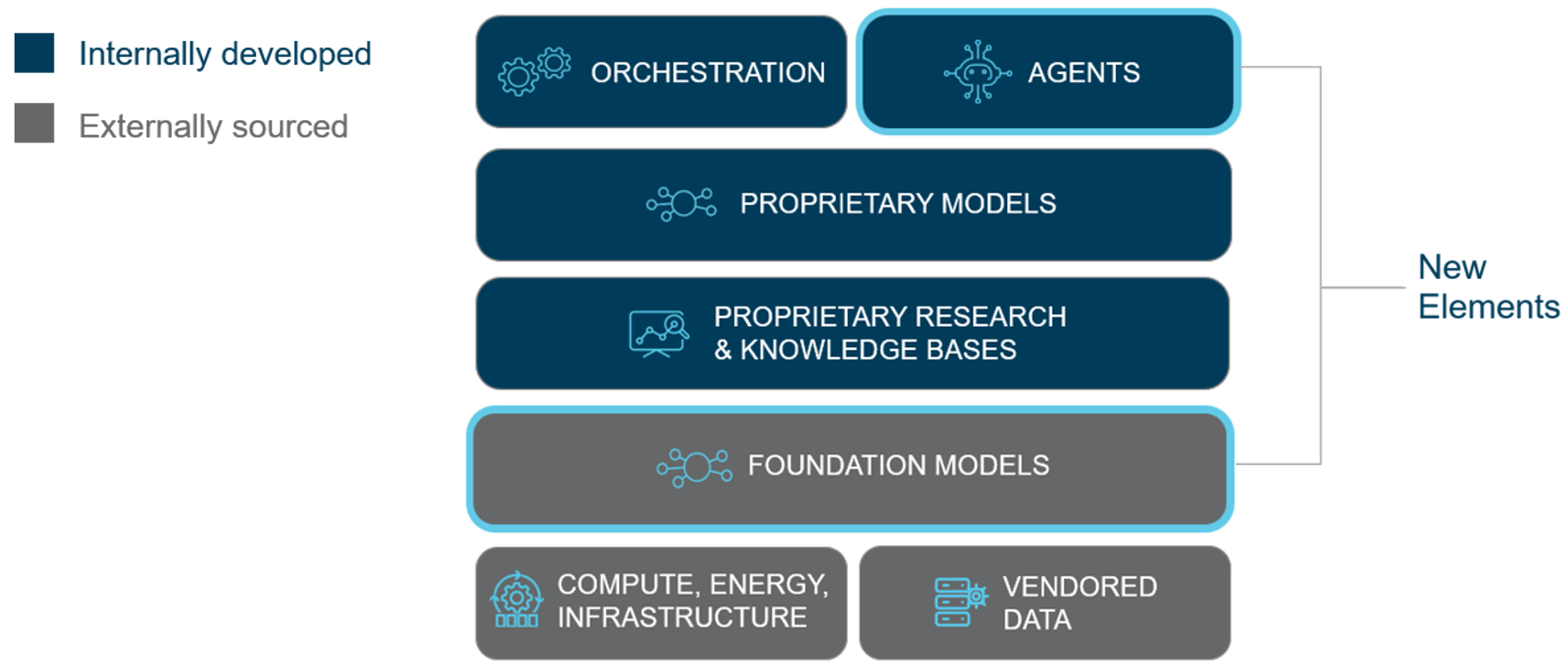
Exhibit 1 depicts the resulting structure. Three features warrant special mention.
Source: Acadian.
First, there are new elements, which we have emphasized with bright blue borders. Foundation models add broad, general-purpose capabilities that can be applied across research, coding, information processing, and other investment tasks. AI agents build on those models to carry out sequences of tasks with a degree of discretion, for example, proposing, testing, rejecting, and refining candidate analyses. Orchestration, i.e., the coordination of models, tools, data, and workflows, is not itself new, but it has become more important as managers integrate externally sourced foundation models and proprietary agents with the more traditional analytical components that remain part of the investment process.
Second, there has been a shift in the boundary between what is externally sourced (gray) and internally developed (blue). Some analytical elements, notably foundation models and much of the infrastructure supporting them, now sit on the sourced side of the stack, while proprietary investment research, models, knowledge bases, agents, and workflows remain manager-specific.
Third, the sources of investment edge have shifted upward in the stack. As foundation models and supporting infrastructure have become broadly available, managers need to devote less effort to building general-purpose analytical machinery themselves. They can and must focus more of their work on developing proprietary investing resources, including models, workflows, and knowledge bases, built on top of the externally sourced technologies.
Modern AI is not just changing the structure of the analytical stack in systematic investing; it is also accelerating a longstanding trend toward “abstraction,” i.e., the transfer of responsibility from people to systems. Agents can increasingly exercise discretion over the analytical process itself, rather than simply executing specified tasks. They can help to define, sequence, and refine the tasks required to pursue an objective.
Greater abstraction does not eliminate the need for human involvement, however; far from it. As systems take on more of the analytical work, higher-level human decisions become more consequential because they govern downstream activity of greater scope and scale, much of which may not be transparent. Moreover, specifying objectives, setting constraints, and establishing validation standards all require deep contextual knowledge and experiential judgment. And even with well-designed ex ante guardrails, ex post human judgment is required to assess whether AI-generated analysis is sound.
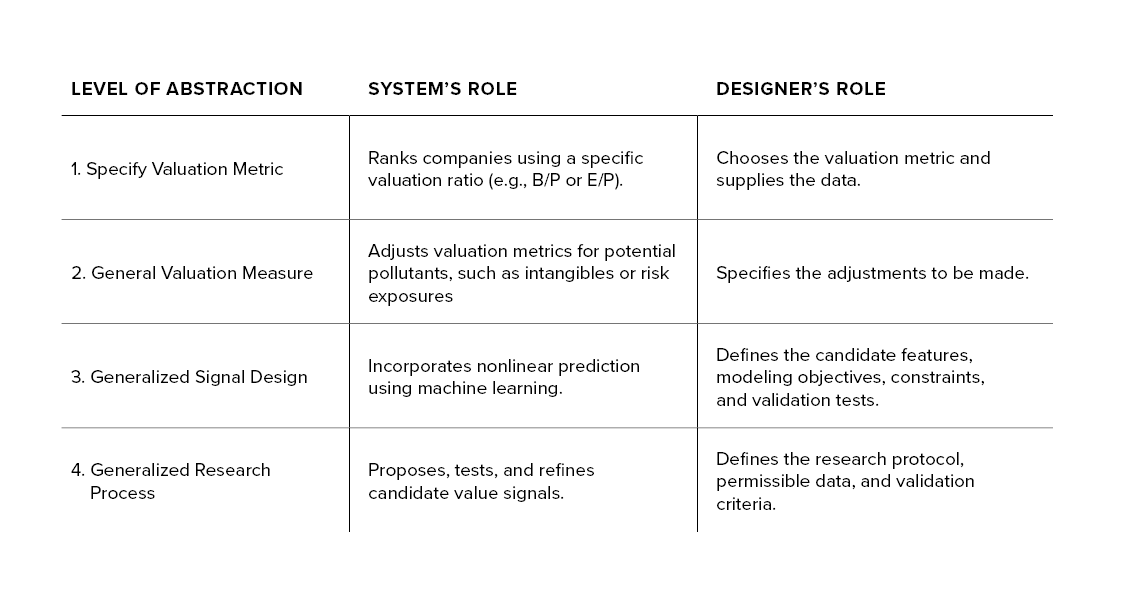
Table 1 illustrates the longer arc of abstraction in the investment process using the evolution of value-signal design as an example. Across the first three levels, systems assume progressively greater responsibility for decisions within a researcher-defined problem. At the fourth, the character of abstraction changes: an agentic research process takes some discretion over the research path itself.
Source: Acadian.
While abstraction may be easiest to envision in the context of forecasting, similar progressions apply to other parts of the investment process, including data ingestion, portfolio construction, implementation, risk management, and trading.
 | Foundation Models: A Surprisingly Simple Way to Understand Them Any analytical model can be understood by answering three questions: What are its inputs and outputs? What are the functional elements that relate the two? How are the functional elements determined? The scale and flexibility of their parameters are what make foundation models so broadly capable and their training so demanding, requiring enormous datasets, specialized computing infrastructure, and sophisticated methodologies. |
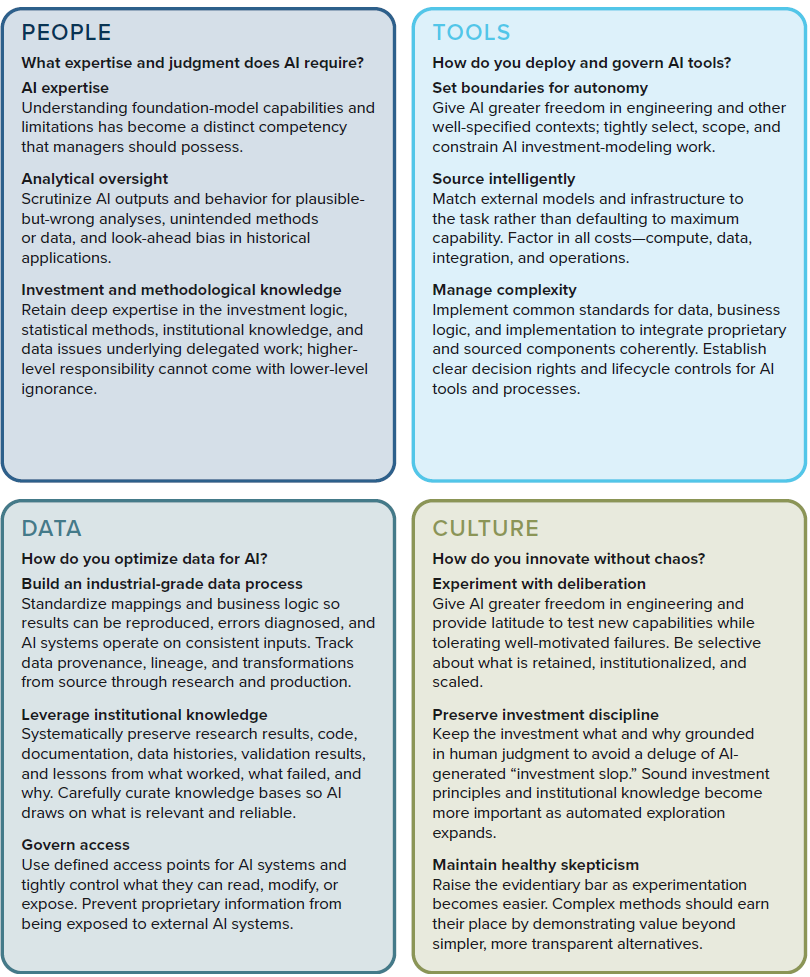
It is easier to trace AI’s broad impact on how analytical work is being done in systematic investing than it is to assess which managers will deliver better active performance through their use of AI. That evaluation must look beyond AI technologies themselves, to organizational characteristics that will be crucial to determining which managers succeed: people, tools, data, and culture. Exhibit 2 poses pragmatic questions that asset owners can use to evaluate managers and highlights key practices and capabilities that strong answers should reveal.
Source: Acadian.
Many discussions about AI get lost in projections about distant future states, where we simply cannot know what the technology or its implications will ultimately look like. Focusing instead on the here and now, the transition to modern AI in systematic investing is marked by a combination of transformative change and continuity. The analytical architecture underlying the investment process is being reshaped, but the underlying investment problem remains the same.
For asset owners, a practical challenge is to assess whether a manager’s use of AI is likely to result in better investment outcomes. Doing that requires examining more than the AI technologies a manager chooses. Whether those technologies produce better active performance also depends on how the manager’s people, tools, data, and culture compare with those of its competitors.
These materials provided herein may contain material, non-public information within the meaning of the United States Federal Securities Laws with respect to Acadian Asset Management LLC, Acadian Asset Management Inc. and/or their respective subsidiaries and affiliated entities. The recipient of these materials agrees that it will not use any confidential information that may be contained herein to execute or recommend transactions in securities. The recipient further acknowledges that it is aware that United States Federal and State securities laws prohibit any person or entity who has material, non-public information about a publicly-traded company from purchasing or selling securities of such company, or from communicating such information to any other person or entity under circumstances in which it is reasonably foreseeable that such person or entity is likely to sell or purchase such securities.
Acadian provides this material as a general overview of the firm, our processes and our investment capabilities. It has been provided for informational purposes only. It does not constitute or form part of any offer to issue or sell, or any solicitation of any offer to subscribe or to purchase, shares, units or other interests in investments that may be referred to herein and must not be construed as investment or financial product advice. Acadian has not considered any reader's financial situation, objective or needs in providing the relevant information.
The value of investments may fall as well as rise and you may not get back your original investment. Past performance is not necessarily a guide to future performance or returns. Acadian has taken all reasonable care to ensure that the information contained in this material is accurate at the time of its distribution, no representation or warranty, express or implied, is made as to the accuracy, reliability or completeness of such information.
This material contains privileged and confidential information and is intended only for the recipient/s. Any distribution, reproduction or other use of this presentation by recipients is strictly prohibited. If you are not the intended recipient and this presentation has been sent or passed on to you in error, please contact us immediately. Confidentiality and privilege are not lost by this presentation having been sent or passed on to you in error.
Acadian’s quantitative investment process is supported by extensive proprietary computer code. Acadian’s researchers, software developers, and IT teams follow a structured design, development, testing, change control, and review processes during the development of its systems and the implementation within our investment process. These controls and their effectiveness are subject to regular internal reviews, at least annual independent review by our SOC1 auditor. However, despite these extensive controls it is possible that errors may occur in coding and within the investment process, as is the case with any complex software or data-driven model, and no guarantee or warranty can be provided that any quantitative investment model is completely free of errors. Any such errors could have a negative impact on investment results. We have in place control systems and processes which are intended to identify in a timely manner any such errors which would have a material impact on the investment process.
Acadian Asset Management LLC has wholly owned affiliates located in London, Singapore, and Sydney. Pursuant to the terms of service level agreements with each affiliate, employees of Acadian Asset Management LLC may provide certain services on behalf of each affiliate and employees of each affiliate may provide certain administrative services, including marketing and client service, on behalf of Acadian Asset Management LLC.
Acadian Asset Management LLC is registered as an investment adviser with the U.S. Securities and Exchange Commission. Registration of an investment adviser does not imply any level of skill or training.
Acadian Asset Management (Singapore) Pte Ltd, (Registration Number: 199902125D) is licensed by the Monetary Authority of Singapore. It is also registered as an investment adviser with the U.S. Securities and Exchange Commission.
Acadian Asset Management (Australia) Limited (ABN 41 114 200 127) is the holder of Australian financial services license number 291872 ("AFSL"). It is also registered as an investment adviser with the U.S. Securities and Exchange Commission. Under the terms of its AFSL, Acadian Asset Management (Australia) Limited is limited to providing the financial services under its license to wholesale clients only. This marketing material is not to be provided to retail clients.
Acadian Asset Management (UK) Limited is authorized and regulated by the Financial Conduct Authority ('the FCA') and is a limited liability company incorporated in England and Wales with company number 05644066. Acadian Asset Management (UK) Limited will only make this material available to Professional Clients and Eligible Counterparties as defined by the FCA under the Markets in Financial Instruments Directive, or to Qualified Investors in Switzerland as defined in the Collective Investment Schemes Act, as applicable.