U.S. equity market structure is complex and fragmented. One consequence of this tangled plumbing is that it fosters conflicts of interest when brokers place stock orders on behalf of their customers. In this paper, we examine one such conflict that involves a controversial practice known as volume-based exchange pricing, whereby stock exchanges offer incentives, in the form of lower execution fees or higher rebates (positive payments), to member firms, including brokers, that trade more on their venues.1
In the U.S., broker-dealers have traditionally absorbed execution fees and rebates rather than passing them through to the investors whose orders they represent in the market. As a result, intermediaries’ routing decisions may be dictated by their profit motive at the expense of their customers’ best interests. Volume-based pricing significantly exacerbates this conflict, by amplifying brokers’ financial incentives. As a result, the SEC recently proposed to ban the practice. In this paper, we highlight the impact of cost-sensitive order routing for investors in U.S. equities. We argue that the proposed ban on volume-based pricing, while a step in the right direction, does not go far enough to combat distortions in brokers’ routing decisions that persist under the current system. Even though order routing may seem a dry and distant topic to asset owners, we would encourage them to take note, because it directly affects the performance of the equity strategies in which they invest.
Exchanges’ Inducements for Order Flow
U.S. stock exchanges are for-profit entities that generate revenue from brokers and other member firms2 through three types of fees – connectivity, market data, and transaction-based.3 While an exchange’s connectivity and market data revenue does not vary with member firms’ activity, its transaction-based revenue varies with the volume that the exchange can attract and execute.
Transaction-based revenue derives from executions on the exchange by member firms, including those of brokers representing customer orders. Generally speaking, for every completed transaction, a member either pays a fee to or receives a rebate from the exchange. Fees and rebates are venue specific. Each exchange chooses its own transaction-based pricing model and sets an associated fee/rebate schedule.
Across U.S. stock exchanges, there are three pricing models: maker-taker, inverted (taker-maker), and fee-fee, which differ in terms of whether the liquidity taker or liquidity provider in a transaction pays a fee or earns a rebate. The following table summarizes key differences.
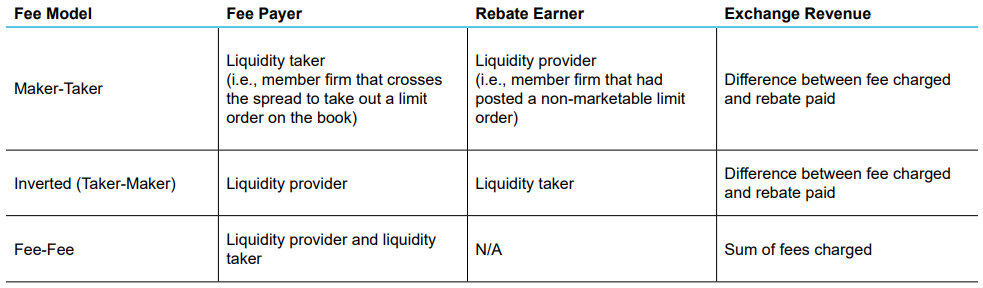
To maximize their profit potential, some exchange operators preside over multiple exchange venues with different pricing models. NYSE operates 5 (3 maker-taker, 1 inverted, 1 fee-fee), Cboe operates 4 (2 maker-taker and 2 inverted), and Nasdaq operates 3 (2 maker-taker and 1 inverted). Diversifying across pricing models allows the parent company to use rebates to attract both liquidity-providing and liquidity-removing orders.
In attracting order flow, volume-based pricing has become an important lever for exchanges.4 Volume-based pricing incentivizes member firms to route orders to an exchange by lowering fees charged or increasing rebates paid if their total monthly volume of executions exceeds a preset exchange-specific threshold (a volume “tier”). An example clarifies. Nasdaq pays a base-level rebate rate of $0.0018 per share for posted limit orders that result in an execution; however, if a broker executes enough liquidity-providing client orders on Nasdaq to meet their highest volume tier, that broker would receive an enhanced rebate of $0.00305 per share for all rebate-eligible transactions executed over the course of the prior month, a 70% increase from the base rate.5
As a result, the fee that a broker would be charged, or the rebate that it would earn, to execute a customer’s buy or sell order may vary dramatically across exchanges, and pricing has become bewilderingly complex.
Impact on Broker Behavior
In trading on behalf of an institutional customer, a broker may choose to execute by posting a limit order, i.e., providing liquidity, or by routing a market order, i.e., removing liquidity. The decision on how and where to execute reflects multiple influences. One of them is maximization of rebate income from the exchanges. That’s because brokers are the typical beneficiaries of any economic incentive offered by the exchanges in the form of rebates or reduced fees. In most cases, brokers do not (directly) pass them on to their customers who typically pay fixed commission rates for execution services.
The stakes involved in brokers’ routing decisions are material. Brokers trade hundreds of millions of shares per day on behalf of commission-paying clients. With the average institutional commission rate to trade U.S stocks currently hovering between $0.0050 - $0.01 per share, rebate rates and fees, both typically in the range of $0.0020 - $0.0030 per share, can represent a significant boost to or drag on a broker’s revenue.
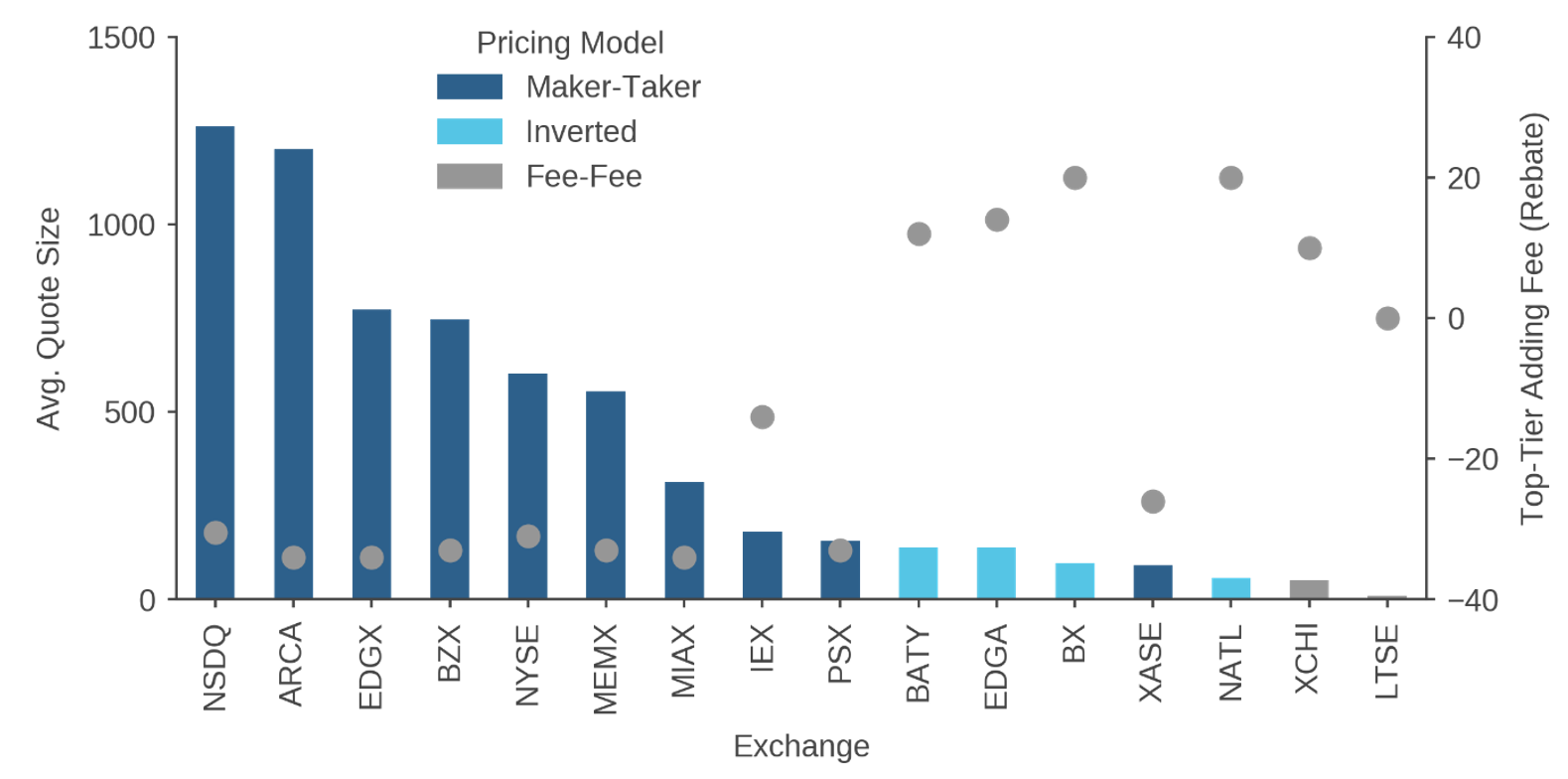
Given those economics, it is hardly surprising that empirical evidence shows that fee-based incentives affect member firms’ routing decisions. Figure 1 on the first page, for example, shows that member firms prefer to post liquidity-providing limit orders on maker-taker venues where they can earn rebates. Average quote sizes resting on such exchanges (dark blue bars) are much larger than on inverted and fee-fee exchanges (aqua and gray bars) where posting incurs a fee.
Figure 1: Evidence of Cost-Sensitive Order Routing—Liquidity Providing Limit Orders by Exchange
Average Quote Size Versus Top Tier Lit adding Fee (Rebate); Jan 1 – Jun 20, 2024
Source: IEX Group Inc. Used with permission. Data sourced from fee schedules provided on exchange websites; avg quote sizes sourced from NYSE TAQ data. For illustrative purposes only.We also observe cost-sensitive behavior for liquidity-removing orders. Evidence is presented in Figure 2, which summarizes an analysis from BestEx Research.6 For a given exchange identified at the top of a column, the value in each cell captures the percentage of instances that it received and executed, i.e., “won,” a spread-crossing order while displaying a quote at the same inside price (either bid or offer) as the exchange indicated in each row.
Figure 2: BestEx Research “WinMatrix”
Percentage of instances in which exchange at top of column received and executed (“won”) a spread-crossing order versus exchange in each row when both were quoting at inside price
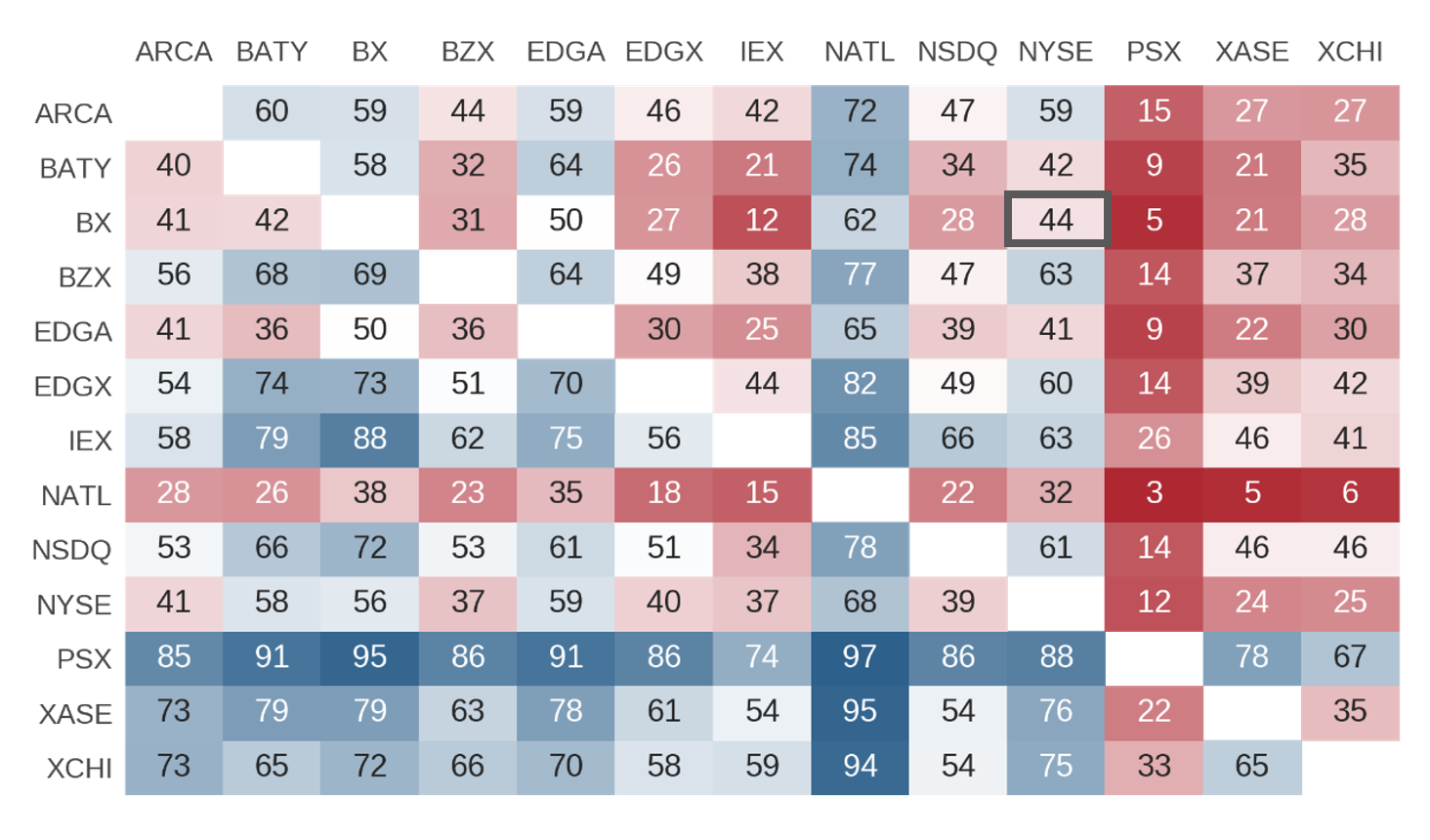
Source: BestEx Research. For illustrative purposes only. See also Hitesh Mittal, Kathryn Berkow, and Johnson Zachariah, Queue-jumping & Strategic Limit Order Routing, 2020.Representative of the key result, the box with the bold outline indicates that NYSE, a maker-taker exchange that charges a fee for removing liquidity, won a liquidity-removing order only 44% of the time when it and the Nasdaq BX, an inverted exchange that pays a rebate for taking liquidity, were quoting at the inside price. Nasdaq BX won the other 56%. To generalize, scanning the matrix reveals that the four inverted exchanges, BX, BATY, EDGA, and NATL, won liquidity taking orders at least 56% of the time when displaying a quote at the same price as any maker-taker or fee-fee venue. Moreover, the venue with the highest overall win rate, NATL (NYSE National), pays the highest rebate for liquidity-removing orders among all the inverted exchanges. Academic research corroborates these results.7
This evidence indicates that exchange incentives have their intended effect in influencing flows. Trading firms, including brokers representing agency clients, prefer to trade on venues that pay them rebates. The key question for investment managers and asset owners, whose portfolios the brokers are trading, is whether cost-sensitive routing is harming their interests.
Cost to Investment Managers and their Clients
Although brokerage firms are profit-maximizing businesses, they are also regulated entities with a best-execution obligation. In managing an order received from a client, therefore, the broker has an obligation to route the trade in a manner that reduces the client’s implicit execution cost, i.e., the market impact.8 But U.S. market structure has (d)evolved into a state in which agency brokers often are forced to choose between their clients’ best interests and their own bottom lines. Unfortunately, research has shown that cost-sensitive order routing has damaged several measures of execution quality.
For example, there is evidence of greater adverse selection associated with cost-sensitive order routing. A commonly used measure of adverse selection is known as a trade markout, which is simply the difference between the execution price of the stock and the subsequent midpoint price after a fixed amount of time has elapsed, e.g., one second. In the case of a buy, a negative one-second markout would indicate that one second after an execution, the price of the stock had ticked lower, suggesting that the broker could have achieved a more favorable price for the customer had it waited to execute the purchase. A positive markout would imply that, one second after the execution, the midpoint price remained higher than the execution price, to the customer’s benefit.
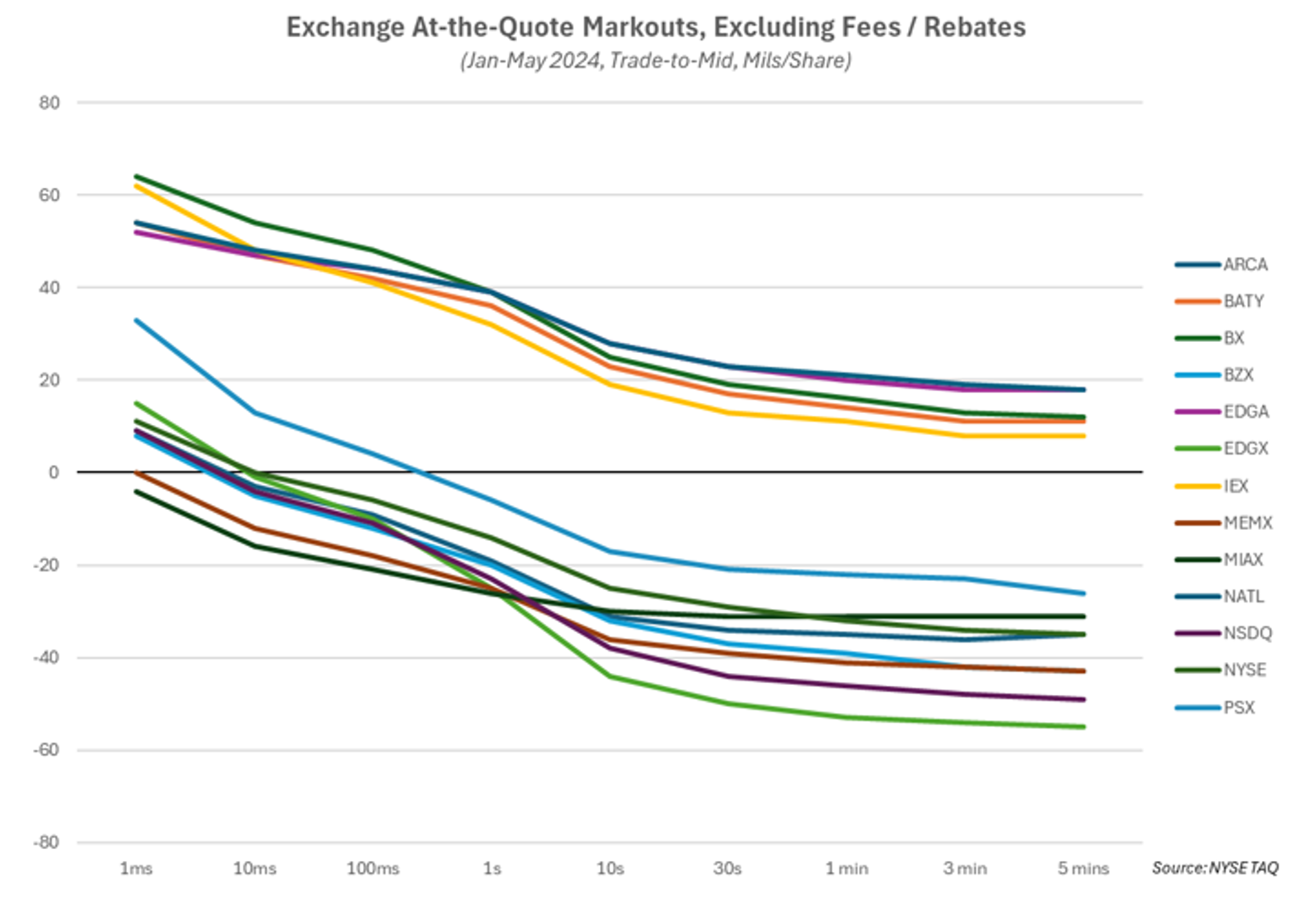
Research suggests that limit orders posted on maker-taker exchanges, which offer rebates for doing so, result in the least favorable markouts, whereas similar orders placed on inverted and fee-fee exchanges result in the most favorable. Figure 3, from IEX Group, provides evidence.9 The various traces record average markouts across multiple time intervals for a subset of exchanges. Markouts on maker-taker exchanges are significantly lower than those exhibited on inverted venues (BATY, BX, EDGA, NATL) and IEX, as large as $0.0040 to $0.0050 per share. Said differently, immediately after receiving a liquidity-providing execution on a maker-taker exchange, the end investor is up to half a penny worse off than it would have been had it received the same fill on an inverted exchange or on IEX10, strong evidence of greater adverse selection.11
Figure 3: Trade Markouts on Non-Marketable Limit Orders by Exchange
Exchange At-the-Quote Markouts, Excluding Fees/Rebates (Jan-May 2024, Trade-to-Mid, Mils/Share)
Source: IEX Group Inc. Used with permission. For illustrative purposes only. For an earlier version of the exhibit, see Wah, Elaine, Stan Feldman, Francis Chung, Allison Bishop, Dan Aisen, A Comparison of Execution Quality across U.S. Stock Exchanges, 2017.There is also evidence of the conflict of interest in time-to-fill and fill-rate metrics of execution quality. Time-to-fill measures how long a liquidity-providing order remains on a limit order book before a liquidity-removing order crosses the spread to interact with it. Shorter is generally better, because it minimizes market variation and risk of information leakage about the investor’s trading intentions between order placement and execution. Fill rate simply refers to the proportion of an order that gets executed, higher being better.
Figure 2 showed that among venues displaying identical prices, liquidity removers typically take from the one that offers the highest rebate/lowest fee. It should come as no surprise then that for liquidity providing orders, times-to-fill are longer (worse) on maker-taker exchanges than on inverted and fee-fee venues. Similarly, limit order fill rates on inverted and fee-fee venues are higher than on maker-taker exchanges.12
The foregoing evidence of cost-sensitive routing’s impact on execution quality relates to executions of individual (“child orders”) routed to an exchange. While helpful, it does not provide a clear sense of the impact on the execution quality of the large-scale orders that institutional investors generally send to their agency brokers. To minimize price impact, brokers often trade those larger “parent orders” through their algorithmic strategies, which break them down into smaller child orders that get routed to exchanges over some time horizon. Absent specific instructions from its client, the broker maintains discretion over the algorithm’s choice of trading venue and order type for each child order submission.
At the parent level, there is also evidence that cost-sensitive routing harms performance. Clearpool Group, an agency broker-dealer specializing in electronic trading solutions and execution transparency, found that a fee-sensitive router exhibited worse performance versus a VWAP benchmark as compared to a fee-agnostic router, while a blended router that balanced trade-offs between fee-sensitive and fee-agnostic methods landed in the middle.13
A Flawed Counterargument
Defenders of the status quo have argued that volume-based pricing is commonplace in most industries and that the public equity marketplace should be no different. In a statement issued shortly after the proposed ban on volume-based exchange pricing was made public, for example, SEC Commissioner Hester Peirce pointed out that warehouse stores offer bulk discounts.14
The flaw in Peirce’s analogy, however, is that it only applies if the end-user is also the beneficiary of the price discount. As she noted, the warehouse stores cut annual checks to their customers based on how much they spend. But this does not hold true in the case of volume-based exchange pricing or in the broader context of inducements paid by exchanges to attract broker flow. In both cases, the end users – including institutional asset owners – pay the non-discounted price of the stocks they purchase in the market, while the intermediary broker pockets the rebates (discounts). Moreover, published research indicates that the (non-discounted) prices that investors receive as a result of their executing brokers’ cost-sensitive routing decisions are worse than if the brokers weren’t routing to maximize rebate payments.
Conclusion
In the convoluted U.S. equity market structure, payments of rebates that exchanges offer to attract flow create a blatant conflict of interest for member firms trading on behalf of agency clients. Volume-based exchange pricing exacerbates the conflict, but it is not the root cause. Therefore, while we are supportive of the SEC’s proposal to ban volume-based pricing, we believe that conflicts associated with cost-sensitive order routing warrant more expansive regulatory scrutiny. While the issue has drawn attention from execution staff at institutional investment managers, asset owners should also take note, in light of the potential harm to the performance of their portfolios.


