To err is human. Human errors sometimes result in crazy market prices. A recent example is the quantum computing frenzy peaking in December 2024, when enthusiastic retail investors bought quantum stocks including Quantum Corporation, Quantum-SI, QuantumScape and Quanta Services.[1] The only problem is that none of these firms are actually engaged in quantum computing; their names are meant to sound cool, not describe their business operations.
In two cases, this investor confusion seems to have impacted market prices. In the last two months of 2024, Quantum Corporation was up 1,151% while Quantum-SI was up 285%.
Retail investors blindly purchased stocks with “quantum” in their name, only a minority of which were actually involved in quantum computing. Now, buying a stock based only on its name is a stupid approach to investing. But retail investors in late December did something even worse; they purchased “quantum” stocks at greatly inflated prices, thanks to the earlier wave of stupid buying.
Shiller (2019) describes an episode allegedly taking place in the summer of 1929, involving the confusingly-named Seaboard Air Lines Railroad Company. He gives the following account from Allen (1931):
Thousands speculated--and won, too--without the slightest knowledge of the nature of the company upon whose fortunes they were relying, like the people who bought Seaboard Air Line under the impression that it was an aviation stock. Grocers, motormen, plumbers, seamstresses, and speakeasy waiters were in the market.
The story of Seaboard Air Lines is a charming anecdote which I’ve shared with generations of students since the late 1990s. However, I must confess that I’m unaware of any evidence that the anecdote is true. Here, I present hard evidence from trades and prices, showing that investor mistakes result in crazy prices that are not swiftly corrected.
Will future historians compare the U.S. stock market of 2024 to that of 1929, with clueless retail activity as an omen of the inevitable collapse? I don’t know, but erroneous stock prices do not seem like a good sign.
The quantum computing frenzy
The frenzy began with positive news about quantum computing, announced by Amazon (November 22)[2] and Google (December 9).[3] Here’s a sample headline from December 11:[4]
Quantum-computing stocks are soaring as investors place bets on ‘the next big thing’ in tech
The news led to price increases in both legitimate quantum computing stocks (including those not having “quantum” in their name) and stocks with “quantum” in their name.
In understanding retail investors, it’s useful to know that in the U.S., the “median individual investor spends approximately six minutes on research per trade” according to Laarits and Wurgler (2025). I don’t have data on U.S. retail investors, so here I study the U.S. stock market activity of Korean retail investors.
Table 1 shows seven “quantum” stocks purchased by Korean retail investors in November and December 2024. Let me explain the nature of the data. The Korea Securities Depository makes available the list of top 50 net buys of retail investors. Thus, I do not observe retail activity for all stocks, only for stocks that happen to be in the top 50 net buys. I construct Table 1 by looking at all daily net buys and finding all common stocks with company names containing “quantum” or “quanta.”[5] I ignore other actual quantum computing stocks without “quantum” names.
Table 1 shows that of the seven “quantum” stocks purchased by Korean retail investors during this period, only three were actually involved in quantum computing. I classified a stock as being an actual quantum computing stock if the phrase “quantum computing” appeared in its latest annual report.
Table 1: “Quantum” stocks bought by Korean retail investors, November and December 2024
| Actual quantum computing? | “Quantum computing” mentions in annual report | Industry |
Arqit Quantum | Yes | 27 | Software & Services |
D-Wave Quantum | Yes | 282 | Software & Services |
Quanta Services | No | 0 | Capital Goods |
Quantum Computing | Yes | 43 | Software & Services |
Quantum Corporation | No | 0 | Technology Hardware & Equipment |
QuantumScape | No | 0 | Automobiles & Components |
Quantum-SI | No | 0 | Pharma, Biotech, & Life Sciences |
Annual report is 10-K or 20-F. All common stock traded on NYSE or Nasdaq, containing “quant” and appearing in the top 50 daily net buying list for November 2024 and December 2025. Sources: Acadian, Korea Securities Depository. For illustrative purposes only.
As confirmation that Korea is representative of retail buying as a whole, I examined data from Moomoo, a global retail broker with customers in the U.S. as well as Australia, Canada, Japan, Malaysia, and Singapore. There’s a high degree of overlap with Korean net buys and Moomoo’s “heat list” based on customer holdings and searches. For example, on December 27, 2024, five of the seven stocks in Table 1 were in the top 50 Moomoo heat list. So, I think it is safe to assume that all retail investors, not just Korean retail investors, were also confused.
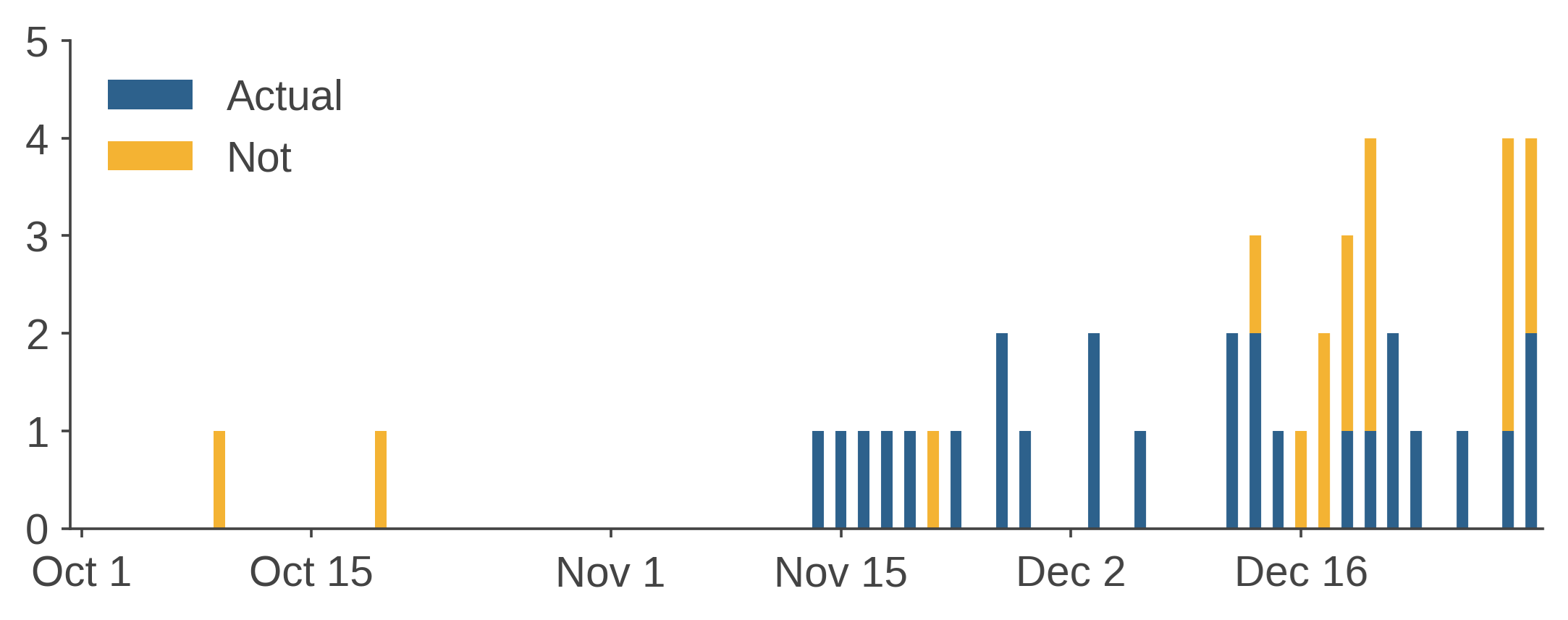
Figure 1 shows the time pattern of retail buying for the stocks in Table 1. For each trading day, I count the number of “quantum” names appearing in the top 50 net buys of Korean retail investors; the maximum possible is seven and the minimum is zero. “Actual” indicates actual quantum computing stocks and “Not” indicates other stocks.
Figure 1 shows that Korean retail investors had little interest in “quantum” stocks until mid-November. Net buying focused on actual quantum computing stocks in late November and early December, and then widened to include stocks that merely have “quantum” in the name in later December. On the last trading day of the year, for example, four of the top 50 securities purchased by Korean retail investors have “quantum” in their name, of which only two are actually engaged in quantum computing.
Figure 1: Count of “quantum” stocks in daily net buying by Korean retail investors
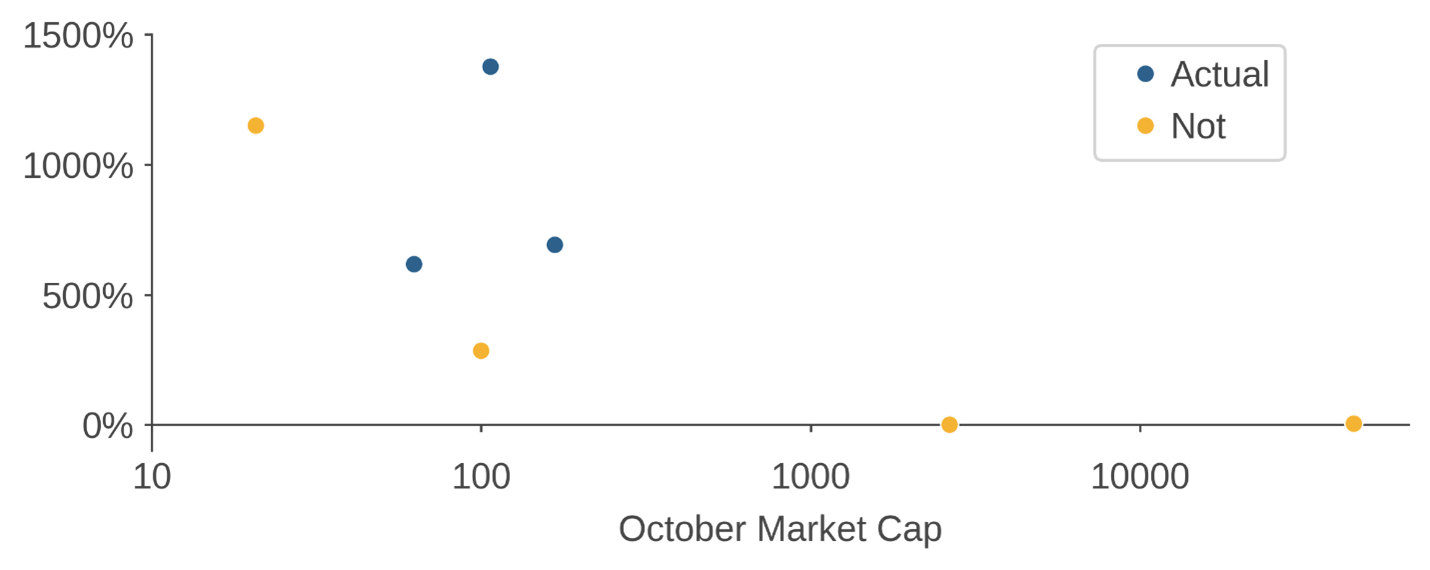
Source: Acadian based on data from the Korea Securities Depository. For illustrative purposes only.Figure 2 shows the total return from October 2024 to December 2024 on the seven “quantum” stocks versus their October month-end market cap. I use the same color scheme as Figure 1. In a rational world, you’d expect the blue points and the yellow points to show radically different patterns. Instead, we see two yellow points indicating prices that more than triple.
What happens when a wave of “dumb money” hits seven stocks? Figure 2 shows the answer. For large-cap stocks, the answer is: nothing. If float or market cap is large enough relative to uninformed buying, price does not change. These are the rightmost yellow points. For small-cap stocks, the answer is: price goes up. A lot. These are the leftmost yellow points.
Figure 2 shows that what seems to matter is not the truth, but rather the stock’s pre-frenzy market cap. If a stock (a) had “quantum” in the name, (b) had market cap under $200M and (c) experienced retail buying, then its price went up 3X or more, regardless of its underlying true business.
Figure 2: Return from October 31 to December 31 Versus October market cap
Source: Acadian. For illustrative purposes only.Investor confusion in perspective
In the Korean stock market, there are many cases of mistaken identity that seemingly impact stock prices and remain uncorrected for months. These cases sometimes involve individuals who have the same last names as political candidates. I’ve previously described two of these cases, “the wrong Ban” and “the three Yoons.”
In the case of the three Yoons, the impacted firm “clearly stated that the firm's business has nothing to do with the politician,” yet retail investors ignored the clarifications and the price remained crazy. I call that “market nihilism.” I’m not sure the quantum confusion of 2024 was nihilistic or just plain erroneous. That is, I’m unaware of any evidence that retail investors knew these stocks weren’t actually quantum computing stocks. Instead, Figure 2 seems more consistent with ignorance.
In U.S. markets, investor confusion has always been present on a small scale for pairs of companies with similar names or tickers. An example from 2021 was Zoom Video Communications versus Zoom Technologies. This confusion typically manifests itself in trading volume rather than in prices. Balashov and Nikiforov (2019) study an extensive list of pairs of stocks with similar names/tickers, and find that as much as 5% of volume is attributable to confusion.
Rashes (2002) was able to find one pair of companies where:
there is a significant correlation between returns, volume, and volatility at short frequencies. Deviations from "fundamental value" tend to be reversed within several days, although there is some evidence that the return comovement persists for longer horizons. Arbitrageurs appear to be limited in their ability to eliminate these deviations from fundamentals.
In the case of Zoom, U.S. regulators intervened in 2021, halting trading and requiring one of the firms to change its ticker.
Firm reactions
How should “quantum” companies respond to investor confusion? One possible response is to issue equity, thus benefitting existing shareholders. You could argue that it’s the duty of management to issue equity whenever equity is overpriced, no matter what the cause of the overpricing.
That appears to be the strategy pursued by Quantum Corporation, which in January 2025 announced plans to issue up to $200M in equity.[6] As a benchmark, the market cap of the company in October 2024 was only $21M.
Another possible strategy would be to issue a clarifying statement explaining that the firm is not actually engaged in quantum computing. Consider the LK-99 superconductor frenzy of the summer of 2023, a classic case of Korean stock market craziness that briefly spread to the Chinese and U.S. stock markets. In August 2023, some impacted Chinese firms clarified that they were not involved.[7]
In cases where investor confusion results in a lower stock price, firms may be more eager to clarify. Take, for example, the case of Republic First Bancorp in 2023, when First Republic Bank failed:[8]
“Amid everything going on, Republic Bank would like to make very clear: we are Republic Bank, Inc. (FRBK); we are NOT First Republic Bank (FRC)”.
… Nevertheless, Republic First’s stock plunged by as much as 28% on March 17, the day First Republic’s rescue was announced.
Now, one can imagine a nightmare scenario of cascading confusion in which the failure of First Republic triggers the failure of Republic First, which in turn triggers the failure of another similarly named bank, and so on, resulting in global financial collapse. That did not happen in March 2023; Republic First survived. Ultimately, however, Republic First collapsed in April 2024. While I doubt that the name confusion of March 2023 caused the bank’s failure in April 2024, it probably was not helpful either.
I’m unaware of any “quantum” firm in 2024 pursuing the strategy of clarifying that they have nothing to do with quantum computing. Instead, consider the following facts about Quantum Corporation. The phrase “quantum computing” does not appear in any of the 206 press releases issued by the firm from 2019 to 2024. However, in January 2025, the phrase “quantum computing-inspired algorithms” appears. As of this writing, Quantum Corporation is up 3X from October 2024.
Conclusion
My view is that the quantum confusion of 2024 is a symptom of the general degradation of U.S. stock market quality, part of the “Koreafication” process where the market becomes more retail dominated. I don’t want to overstate the quantitative significance of this trend, because as shown in Figure 2, it’s mostly confined to small-cap stocks. But it appears that bizarre pricing previously confined to pink sheet stocks is now visible in listed smaller names.
To err is human. To err repeatedly and with reckless abandon in a doomed quest to get rich quick is characteristic of retail investors.
References
Allen, Frederick Lewis. Only Yesterday: An Informal History of the 1920s. Harper, 1931.
Balashov, Vadim S., and Andrei Nikiforov. "How much do investors trade because of name/ticker confusion?." Journal of Financial Markets 46 (2019): 100499.
Laarits, Toomas, and Jeffrey Wurgler. "The Research Behavior of Individual Investors." (2025).
Rashes, Michael S. "Massively confused investors making conspicuously ignorant choices (MCI-MCIC).” The Journal of Finance 56, no. 5 (2001): 1911-1927.
Shiller, Robert J. Narrative Economics: How Stories Go Viral and Drive Major Economic Events. Princeton University Press, 2019
Endnotes
[1] References to this and other companies should not be interpreted as recommendations to buy or sell specific securities. Acadian and/or the author of this post may hold positions in one or more securities associated with these companies.
[5] In the English language, quanta is the plural of quantum. Translation software typically translates both “quantum” and “quanta” into the same Korean word, yangja.




